Posts Tagged school

Top 3 Non-Negotiables for Food Allergy Accommodation Plans

Monday, December 8th, 2014 | Permalink

By Gina Mennett Lee, M.Ed.

FoodAllergyConsulting.com

Hopefully, if you have been reading my work, you know that I stress the importance of an individual written plan for each child with a food allergy.  The importance of an individual plan is echoed in the CDC guidelines.   These plans should address strategies to prevent a reaction as well as what to do should a reaction  occur.  Individual accommodations will differ depending on the child’s allergies and the unique educational setting of the school.  However, there are a few accommodations that I personally hold firm as non-negotiables.  These three accommodations will inform the remainder of the necessary accommodations for each child.

hand stop


1. Immediate access to epinephrine: Every allergist I have spoken to or listened to at conferences (and this includes many of top allergists in the United States) stresses the importance of always having epinephrine with the child.  Why should this NOT be the case at school?  When reviewing research and individual cases of food allergy deaths, delay in administration of epinephrine is often one of the most important factors.  Recently, additional research was published drawing a connection between the delay of the use of epinephrine and the increased amount of time a person was hospitalized.  The message is clear, the sooner the epinephrine is administered, the better the outcome.  Make sure every child has immediate access to this life-saving medication.

2. Supervision by trained staff:  This should be a no-brainer.  If the those supervising the child throughout the school day are not trained to identify the signs of an allergic reaction or trained to administer the epinephrine, there will be a delay in treatment or possibly no treatment at all.  This can have dire consequences.  In some states, there are laws that prohibit certain people from administering epinephrine. If this is the case, alternative plans need to be put in place to ensure each child has immediate access to someone that can administer epinephrine.  All staff can be trained to identify symptoms of an allergic reaction and to prevent reactions from occurring.  This supervision must be in place at all times including on the bus or at before and after school activities.

3. Allergen-free classrooms:  This measure is firmly supported by the CDC.  Children attend school to learn. All children deserve to learn in a safe environment.  For children with food allergies this means an environment free of their allergens.  They should not be put in a situation where they are distracted from their primary goal by having to worry about their allergens.  In addition, I  want teachers to be able to focus on teaching rather than the management and proper clean-up of allergens.  Given that 45% of allergic reactions requiring epinephrine begin in the classroom, reducing the amount of “unnecessary food” as well as eliminating allergens is a safe and effective way to reduce the likelihood of a reaction.

Other points to consider:

Allergens can remain on surfaces that appear to be clean.

Research indicates that adults touch their faces numerous times per hour and that children ages 2-5 touch their faces 40 times per hour.  This means that a student with an allergy can unknowlingly touch their allergen and then touch their eyes, nose or mouth and suffer a reaction as a result.

Often these measures are put in place at a young age.  However, teens and young adults should be given the opportunity to learn in an environment free of their allergens as well.  Teens are at a higher risk of a fatal allergic reaction.  We need to continue to protect these children.


These three accommodations are a solid starting point of an effective plan.

Related posts:

Top 3 Actions Every Preschool Must Take to Protect Students with Food Allergies

FREE Food Allergy Training Options for Schools

Food in the Classroom Not About Public Opinion


CYBER MONDAY SPECIAL

Monday, December 1st, 2014 | Permalink

The Preschool Food Allergy Handbook plus FREE Poster!

ONLY $25 and only at LaurelLeeAcademy.com

Allergy Cover


Support Kyle Dine’s Kickstarter Campaign

Friday, November 21st, 2014 | Permalink

Kyle

I first met Kyle in my role as President of Food Allergy Education Network.  We had hired him to be the entertainment for our Dance-a-thon fundraiser.  I had heard some of his songs, but had never seen him in action.

That May, he put on a show that had all the children singing and cheering that “Food Allergies Rock!”  He also sang about important messages like carrying and using epinephrine when needed.  He did it all in a fun, engaging and age appropriate manner using humor, puppets and songs.  I was hooked.  I became a Kyle Dine Fan immediately.

kids dancing with Kyle


Making a diagnosis, that is challenging at best and downright scary at its worst, into something fun and a point of pride is a spectacular feat!  That is why I was very excited when Kyle contacted me to tell me about his idea and to ask me to be an advisor for his new project.  He would like to spread his positive message and educational tools to a broader audience by creating a video.

In order to achieve this goal, he has launched a KickStarter Campaign to raise funds to create this video.  If you believe in using the power of fun and music to help educate children, I hope you will consider donating to this campaign.

(For the record: I was not asked to write about this campaign. I am offering my expertise on this project as a volunteer, not a paid consultant.  I believe strongly in importance of creating fun educational tools for children. )

Heading to Wisconsin!!

Thursday, November 13th, 2014 | Permalink

I am already packed and ready to go!  I am really looking forward to being part of this awesome conference spearheaded by Jenny Schumach of Food Allergy Association of Wisconsin and sponsored by Food Allergy Research and Education.  It is a full day conference jam-packed with fabulous information and best of all, it’s FREE!    It’s important for me to acknowledge Jenny and FARE for all their hard work and financial support of such an important educational conference.  I am honored to be a part of what I view as a true service to the community.  I can’t wait to hear my fellow food allergy educators speak.

I will be discussing one of my favorite topics, “Tools to Help Children Stay Safe and Included at School.”  If you are attending, I hope you will come up and say “hello!”

Check out the conference agenda!

Screen shot 2014-11-13 at 11.14.39 AMFor more information, visit HERE.


Preschool Food Allergy Handbook: Book Release & Sneak Peek

Wednesday, October 22nd, 2014 | Permalink

Allergy Cover


Book release and sneak peek!!

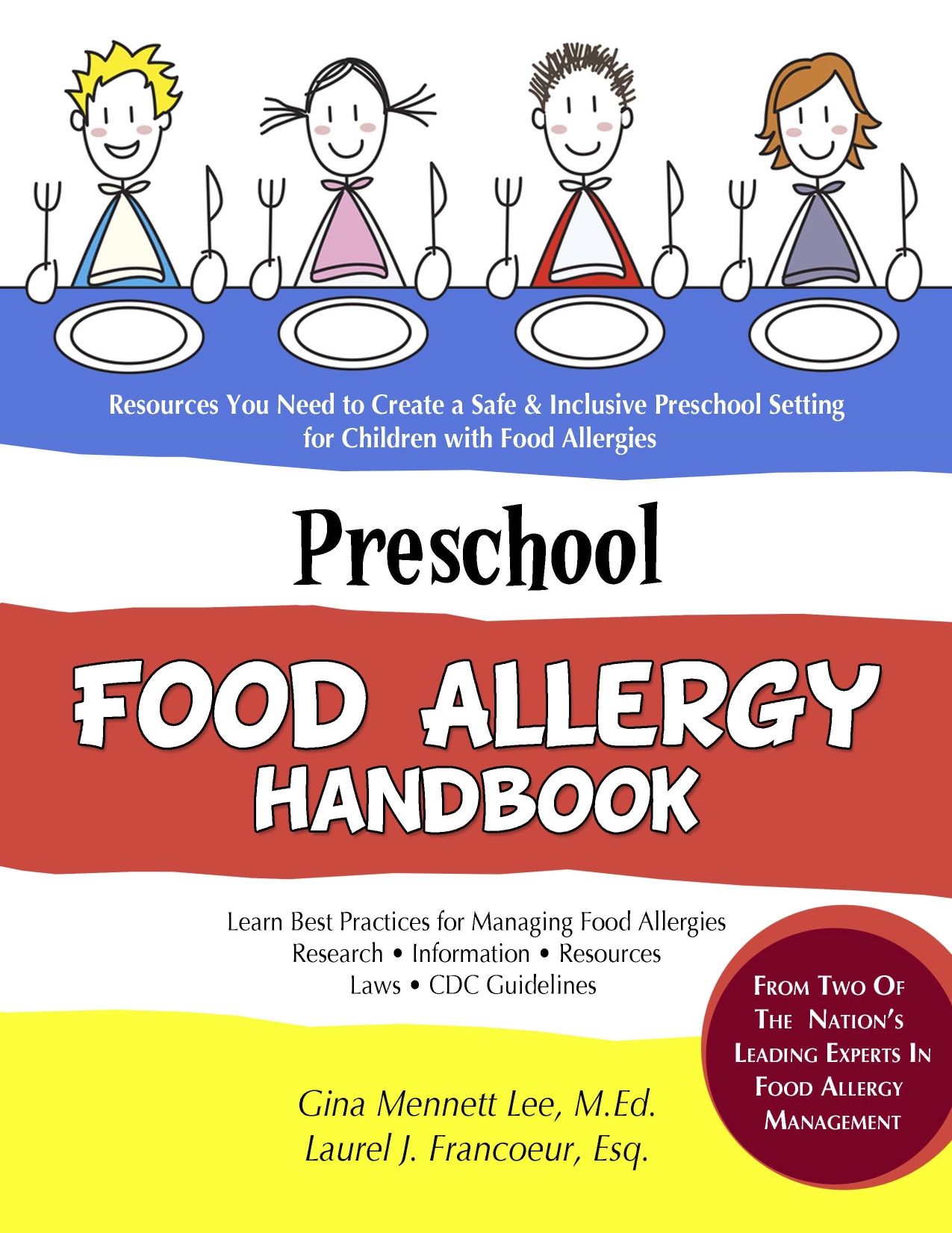
Laurel Francoeur and I put the finishing touches on our new book, the Preschool Food Allergy Handbook, this September. We launched it at the Food Allergy Bloggers Conference and were overwhelmed by the support of this much needed book addressing the preschool setting.

For those of you that aren’t able to meet us in person at one of our book signings, we wanted to give you a little sneak peek.

Screen shot 2014-10-22 at 6.18.46 PMScreen shot 2014-10-22 at 6.17.30 PM


There are so many wonderful resources we created just for this book that cannot be found anywhere else.

  • How Will Your School Prepare for Food Allergy Emergencies?  Important Questions to Answer
  • Overview of Labeling Laws
  • How to Create a Healthy & Safe Educational Environment
  • How to Prevent Cross-Contact
  • Food Allergy Management and Prevention Plan Worksheet
  • Parent Checklist
  • Questions to Ask When Looking for a Preschool


We also included the best resources currently available.

  • How a Child Might Describe a Reaction
  • Label Reading 1-2-3
  • Tips for Avoiding Your Allergen
  • Free Staff Training Options
  • List of Free Educational Resources for Children
  • Children’s Book List
  • Books for Parents List
  • and much, much more….

To order yours, visit Amazon.com.  A special thank you to  The Bugabees: Friends With Food Allergies

and Kyle Dine for sponsoring our book!


New Jersey Food Allergy Educational Conference Resources

Monday, September 15th, 2014 | Permalink

Gina Mennett Lee, M.Ed.

FoodAllergyConsulting.com

This weekend, I was honored to be one of five speakers to present to a SOLD OUT audience in Saddle Brook, NJ hosted by the Asthma and Allergy Support Group of North Jersey.  It was wonderful to see friends old and new.   As promised, I am providing a list of resources that I presented (and a few I didn’t have a chance to present).  Enjoy!

If you didn’t have a chance to at the conference, be sure to sign up for my newsletter by sending your name and email address to: gmleeconsulting@gmail.com.  Also, be sure to sign up for my blog by entering your email to the right—–>>>> under “Subscribe to Blog via Email”.

Thank you!!

P.S.  I also forgot to mention that I wrote a book with Laurel Franceour that will be available to purchase in later this month.  It is called the “Preschool Food Allergy Handbook”.  I will be offering a special price for those that attended the NJ conference.  Stay tuned….

Allergy Cover


Free Posters:

Screen shot 2014-07-16 at 10.55.42 AM

Symptoms of an Allergic Reaction Poster

Label Reading Poster

FINAL Label Poster 8.5×11

FARE Infographic

Infographic from Food Allergy Research and Education

Be A PAL

Be A P.A.L. Poster from Food Allergy Research and Education


Free Online Awareness Videos for Children without Food Allergies:

Hayden’s Food Allergy Video (YouTube): This provides an excellent, simple explanation of food allergies and how to keep friends with food allergies safe.  It is appropriate for preschool through 4th grade.


Books for Children:

The BugaBees: Friends with Food Allergies

The BugyBops: Friends for All Time

The Princess and the Peanut Allergy by Wendy McClure

The Princess and the Peanut by Sue Ganz-Schmitt

The Peanut Free Café by Gloria Koster

Nutley: the Nut-Free Squirrel by Stephanie Sorkin


Free Handbook for School Employees:

The Food Allergy Book: What School Employees Need to Know (www.neahin.org)


Free Printable Activities for Children:

Be A P.A.L. (foodallergy.org)

No Biggie Bunch (nobiggiebunch.com)


National Guidelines for Developing Policy:

Safe at School and Ready to Learn

Voluntary Guidelines for Managing Food Allergy in Schools and Early Care and Education Programs


FARE’s New Resource Is Even Better Than You Think!

Friday, September 12th, 2014 | Permalink

By Gina Mennett Lee, M.Ed.

FoodAllergyConsulting.com

ItScreen shot 2014-09-11 at 8.12.31 PM

Yesterday, Food Allergy Research and Education released “Creating a Food Allergy Safety Zone At Home” and I jumped for joy but not for the reasons you would expect.  While I think this is a fantastic resource for the newly diagnosed, I believe it should be used to reach a much wider audience.  This is the perfect tool to use to teach others about how to safely host someone with food allergies.

A few weeks ago, I took an informal poll on facebook.  I asked, “What is the one aspect of food allergy management that you wish others understood?”  By far, the area people wished others knew more about, was the concept of cross-contact.  I find cross-contact to be the one of  the most misunderstood concepts as well.  People think that the only way to have a reaction is to directly ingest the food.  When, in my personal experience, it’s much more difficult to avoid cross-contact.  This is also what poses the greatest risk when people with food allergies eat away from home.

 It’s the nuances of food allergy management that often are the most difficult to communicate.

Recently, a very kind mother offered to have my 9-year-old daughter over her house for dinner.  She assured me that she would only serve safe foods. I was so thankful for her generous offer.  I felt awful having to then engage in an awkward discussion about the fact that it’s not as easy as only serving safe foods.  I told her about all the precautionary measures that would need be in place in order for my daughter to eat safely.  Thankfully, she took it in stride and seemed willing to take on the responsibility (with help from me).  She even went so far as to offer to host a few parents at her house for a “training” on how to safely host my daughter.  I thought, “What a wonderful person!”  Then, “That’s a great idea, but where do I begin!”

This guide is my answer.  Although many of the tips are specific to the home of the food allergic person, there is a wealth of great information that could be used to educate those that wish to host a person with food allergies.

I love the kitchen dos and don’ts and the examples of direct and indirect cross-contact.  This is exactly what I was looking for.  It is straight-forward, easy to understand, and gives specific tips that can be immediately implemented.  I recommend sharing this with family members, friends, coaches, PTA leaders, and school personnel as a way to communicate the precautions that are necessary to keep a child with food allergies safe when preparing or serving food.

Thank you Food Allergy Research and Education and Chef Joel Schaefer for making a valuable and effective resource!  Now to begin preparing that parent training….


Related topics:

FREE POSTER: How to Read A Label for Food Allergens in 3 Easy Steps

Food Allergy Tips for PTA Leaders

FREE Poster: Symptoms of an Allergic Reaction

Monday, July 28th, 2014 | Permalink

By Gina Mennett Lee, M.Ed.

Food Allergy Educator & Consultant

FoodAllergyConsulting.com


Screen shot 2014-07-16 at 10.55.42 AM


One of the most important skills in managing food allergies is the ability to identify an allergic reaction.  Early identification is critical.  I am sharing this FREE poster with you in hopes that you will download it and use it.  The information provided on this resource is consistent with the CDC Guidelines.

I recommend that these be placed in school cafeterias and classrooms as a reminder to school personnel. Parents and other caregivers may also find it useful to post in the home on the fridge or in the kitchen.

DOWNLOAD HERE:

Poster 8.5 X 11

Poster 11X17

Related posts:

FREE Food Allergy Training Options for Schools

Managing Food Allergies in the Classroom: A Free Guide for Classroom Teachers

Best Resources for Managing Food Allergies in the School Setting


Managing Food Allergies in the Classroom: A FREE Guide for Classroom Teachers

Wednesday, April 9th, 2014 | Permalink


By Gina Mennett Lee, M.Ed.

The number of children with food allergies in the United States is now estimated to be 1 in 13.  This means there are approximately 2 children in every classroom with food allergies.   That number is especially alarming given that children with food allergies can be at risk for having a life-threatening reaction called anaphylaxis.  As a classroom teacher, you spend the greatest amount of time with your students, aside from their families.   You are also most likely to be the person who will first need to respond should a reaction occur.   As a matter of fact, in a study of MA epinephrine use in schools, 45% of symptoms developed in the classroom.  See graph below:

Screen shot 2014-04-26 at 1.08.02 PM


Hopefully your school has implemented a plan for the management of children with food allergies that is consistent with the newly released CDC guidelines.  Whether this has occurred or not, there are still many things you can do as a classroom teacher to ensure that children with food allergies can fully and safely participate in your classroom.   (Please note that older students should be active participants in the management of their food allergies.)

Below are some simple, common sense measures you can implement to ensure that children with food allergies are safe and included in your classroom.

1.    Create a positive climate by fostering an understanding about food allergies.   All eyes are on you and people will follow your lead.  This includes children, parents, and other school employees.

  • Students: It is important to note approximately 50% of children with food allergies report being bullied (31.5% of children with food allergies are bullied specifically due to their allergies).  Consider doing a lesson about food allergies with your students.  There are books and videos available for this use.
  • Other Parents: Speak in a positive manner when discussing food allergy management in your classroom.  I overheard a teacher making a negative comment about a new classroom food allergy policy at a parent night.  As a result, other parents began to discuss food allergies in a negative manner.  This fostered an atmosphere of resentment rather than support. Be aware of how powerful your words and actions are to those around you.

2.   Reduce the risk of accidental exposure

  • Recycled food containers: Are there any food containers being used in your classroom?  If so, get rid of them.  Trace amounts of allergens can be found in these containers.  Even if there were a way to be absolutely sure there were no allergens in the container, it is unsettling for a child to have to use a container of a food he/she has been told not to touch.
  • Soaps and Lotions: Do you have soaps or lotions for use in your classroom?  Check the labels for allergens.  Parents of children with food allergies are a good resource and are often happy to help with this.
  • Art & Craft Supplies: Check the labels for each item to ensure they do not contain allergens.  This may require a phone call to the manufacturer as craft labels are often more difficult to read.   FALCPA (food allergy labeling law) does not apply to these products.  Enlist the help of the parent to the food allergic child.  They may have already checked these products or may be willing to help.
  • Other Classroom Supplies: Go through additional classroom supplies including items such as science experiments and games to ensure they are free of allergens.
  • Food storage:  Where are lunches and/or snacks kept?  Can they be kept in an area that is separate from the learning environment?  Children with food allergies may need a special spot to keep their food that is away from the other foods in order to avoid cross-contact (separate cubby or locker).
  • Hand washing:  It is recommended that children wash hands before and after eating.  Both soap and water, and commercial wipes are effective at removing allergens.  (Please note that hand sanitizers do not remove allergens.)
  • Birthdays, Rewards & Classroom Celebrations: It is recommended that you avoid using food as a rewards or for celebrations.  This will significantly reduce the risk of accidental exposure.  There are additional benefits to this as well.  Children will not associate all fun with food.
  • Food in the classroom:  The safest and easiest option is keep classrooms free of food.  This will automatically reduce the risk of accidental exposure and it has no impact on other children.  It also allows you, as the classroom teacher, the ability to focus on learning rather than food allergy management.   Realizing that this may not always be a possibility, I have created a chart of accommodations needed if food is present in the classroom.

ACCOMMODATIONS NEEDED

Screen shot 2014-04-09 at 12.10.12 PM

 If you or your students eat breakfast, snacks, or lunch in the classroom, there will need to be a system in place to monitor the food being eaten to ensure that they do not contain allergens.  The CDC guidelines recommend that no allergens be present in the classroom.   (If the foods the children are eating are being sent in from home and NOT shared, you may be able to provide a list of “safe snacks” for the other parents in the classroom.  It is important to note, however, that labels and manufacturing practices can change at any time.)   The CDC guidelines also recommend that children wash their hands before and after eating and that all eating surfaces be cleaned.

Do not serve food to any child without the parent’s knowledge and consent.  Gone are the days when you could surprise the class with some homemade cookies.  There are too many risks associated with this, and many other food-related health issues affect children beyond food allergies.  Make it a rule not to serve food without parent knowledge and consent.  Even if you “know” the food is safe, please get permission before serving.  For example, a child with a milk allergy can safely eat watermelon.   However, if the sponge the person used to clean the cutting board for the watermelon was also used to wash a cup that contained milk, there now could be milk proteins present in the watermelon due to cross-contact.

 3.    Communicate

  • School Nurse:  If you are fortunate enough to have school nurse available, speak with him/her about food allergies in general and about the specific needs of the children in your class as soon as possible.  The sooner you are able to do this, the more time you will have to prepare your classroom.
  • Past teachers: Talk to the teacher the child had the previous year to discuss strategies that worked well.
  • Parents/Guardians of Child with Food Allergies: Meet the parents/guardians before school starts to discuss their child’s needs.   Make communication a priority when dealing with the parents/guardians of a child with a food allergy. They will be extremely appreciative.  As an added benefit, they can help you.  Caring for a child with food allergies is a big responsibility and one that they fully understand.
  • Other parents/guardians of children in your classroom: It is considered best practice to not have the child’s allergens in the classroom.  Typically, the school nurse, principal or classroom teacher will send a letter home to classroom parents asking that food containing specific allergens not be eaten in the classroom.  If snacks are consumed in the classroom, it can be helpful to create a list of safe snacks to send home to parents as well.  However, please keep in mind that labels and manufacturing practices can change at any time. Some schools have opted to have only fruits and vegetables for snack time.   The parents of children with food allergies may be willing to offer suggestions for a safe snack list.
  • Be sure to respect the child’s privacy.  It is the law. It’s important not to use the child’s name or give details of the child’s medical history without permission from the parent.
  • Substitute teachers : How will you communicate the needs of the child with food allergies to substitutes?  Will it be in your sub folder?  How will you ensure that the sub reads it?  Will there be a specific sub assigned to your classroom that has been trained and is aware of the needs of the children in your class?
  • Special guests: Whenever someone comes into your room, there is a risk that they may bring something unexpected.  For example, a parent volunteer may walk in with a coffee that contains milk, or a guest speaker may bring in a craft supply that contains an allergen.  Do as much planning as you can in advance.  Discuss guests with the parents of the food allergic child, when possible.  They may be able to anticipate potential risks.   (If the child is old enough, you may discuss it with the child directly.)  Be prepared to respond if someone does bring an allergen into the classroom.  Some teachers post signs outside the classroom as a reminder that the classroom is allergen-free.
  • Field trips:  Again, communicate with the child’s parents/guardians in advance of the trip.  Some things you can prepare for and others you cannot.  The child with food allergies should always be with a chaperone who is trained and has immediate access to the child’s medication.  It’s also good idea to travel with wipes and keep them with you at all times.  It can be helpful for unexpected clean-ups and hand washing.  Always offer to allow the child’s parent to attend field trips.

4.    Be prepared to respond should a reaction occur

  • Training: Have you been trained to recognize the symptoms of an allergic reaction?  Do you know how to respond?   Do you understand the child’s Food Allergy Action Plan/Emergency Care Plan?  Do you know who is repsonsible for administering the epinephrine?  If you are responsible, have you been trained and are you comfortable using the epinephrine auto-injector? Do you know who is responsible for calling  911 and what to say?  (If not, discuss creating a 911 script with your school nurse and/or principal and post it near the phone and keep it with emergency communication devices when away from the classroom.)
  • Emergency Communication: Do you have a way to directly contact emergency services at all times during the school day?  (This includes recess and other times you are not in your classroom.)
  • Medication:  Where will medication be kept?  Is the child old enough to self-carry?  If not, will the medication be kept in your classroom?  (One suggestion is to hang a zippered pouch from a hook that is too high for children to reach but easily accessible to adults.)
  • Don’t be afraid to use the epinephrine auto-injector.  It will save the child. It will not hurt them.  If state law/regulations and local policy allow you to administer epinephrine, ask your school nurse if there is an opportunity to try administering an expired epinephrine injector it into a grapefruit.  This will allow you to experience how a real auto-injector feels.  Depending on the type of auto-injector the child is prescribed, it can feel quite different from the trainer.

5.  Be confident.  Once you have implemented these strategies, you should feel confident that you can provide a safe and welcoming environment that will allow all of your students to grow as learners and as people.


I have created a FREE checklist for managing food allergies in the classroom.  Screen shot 2014-04-09 at 1.05.44 PMScreen shot 2014-04-09 at 1.05.52 PM


* * Data taken from The Management of Life Threatening Allergies in School: Lessons Learned from Massashusetts  By Michael Pistiner MD, MMSc and Anne H. Sheetz RN, MPH, NEA-BC.  

Thank you to Julia Verillo, B.A. Elementary Education (3rd grade teacher in CT), and Tina Stewart, M.Ed. (3rd grade teacher in MA) for reviewing this article.

Resources:

Food Allergen Exposure in the School Setting

The Management of Life Threatening Allergies in School: Lessons Learned from Massachusetts, Epinephrine Administration in Schools Brief Summary

Voluntary Guidelines for Managing Food Allergies in Schools and Early Care and Education Programs 


Resources from Allergy Home

Thursday, March 13th, 2014 | Permalink

I am truly honored to be an expert contributor to the highly respected AllergyHome website.  AllergyHome provides some of the best food allergy resources for the school setting .   AllergyHome’s  mission is to “bring food allergy awareness and education to your community.”   If you haven’t already, please take the time to look through the website. You will find training modules, posters and other fabulous FREE resources.

Today, I’d like to share two resources that I am proud to have been a part of creating.   I will be adding links to these under the resources tab of my website.  (There are other AllergyHome resources listed there as well.)

The first resource is Food Allergy Tips for PTA Leaders but it can be shared with school administrators, nurses, and teachers as well.  I create this Tip Sheet in collaboration with AllergyHome Co-Creator, Dr. Michael Pistiner.

Screen shot 2014-03-13 at 6.45.54 PM


DOWNLOAD HERE:  Tip Sheet for PTA Leaders

Dr. Pistiner also did an excellent blog post for the National PTA entitled, “Anaphylaxis, A How-To Readiness Guide for Schools”  I highly recommend taking the time to read it.

The second resource is Food Allergy Tips for Coaches and Activity Leaders.  Please print this out and share with coaches, scout leaders, after-school program coordinators, etc…

Screen shot 2014-03-13 at 6.49.25 PM

DOWNLOAD HERE:  Food Allergy Tips for Coaches and Activity Leaders

I hope you find these useful.  If you haven’t already, make sure to sign up to receive my blog posts. I will continue to share useful resources as I find them.  If you have additional questions regarding accommodations for children with food allergies, please feel free to contact me.

BUY YOUR COPY TODAY!

"One Stop Food Allergy Book Has It All!" -GratefulFoodie

Subscribe to Blog via Email

Keep up-to-date on the latest news, research and resources in the world of food allergies by subscribing to my blog.

Disclaimer

The information provided on this website is not intended to be used as medical or legal advice, nor is it intended to diagnose health problems, to act as a substitute for a doctor, or to act as a substitute for a lawyer. Nothing on this website can replace the independent judgment of a licensed physician or lawyer. If you, or a member of your family, has or is suspected to have a medical condition, please consult your health care provider. This website is provided on an "as is" basis without warranties of any kind, express or implied, including those of title, merchantability, fitness for a particular purpose. The user assumes all responsibility and risk for the use of this website.