Posts Tagged FARE

FARE Announces College Pilot Program

Thursday, April 9th, 2015 | Permalink

Screen shot 2015-04-09 at 11.40.17 AMImage of College of the Holy Cross, a participant in the FARE pilot program.  (Image from news.holycross.edu)

Choosing the right college is an exciting and sometimes difficult prospect for any young adult.  For those managing food allergies, it can especially challenging.  Finding a college prepared and willing to accommodate food allergies can be just as important as the school’s educational offerings.  That’s why I was thrilled to see FARE’s publication of the “Pilot Guidelines for Managing Food Allergies in Higher Education” as well as the announcement of a pilot program to implement these guidelines.

Twelve schools across the country have agreed to participate.   This impressive list of higher education institutions are to be commended for being leaders in this movement to provide safe and accessible educational environments for those with food allergies.

  • College of the Holy Cross (Worcester, Mass.)
  • George Mason University (Fairfax, Va.)
  • King’s College (Wilkes-Barre, Pa.)
  • North Carolina State University
  • Texas A&M University
  • University of Arizona
  • University of Chicago
  • University of Michigan
  • University of Northern Colorado
  • University of Southern California
  • Valparaiso University (Valparaiso, Ind.)
  • Wesleyan University (Middletown, Conn.)

I look forward to hearing more about this program and I am very excited for the additional options that will be open to young adults entering college in the years to come.  Thank you FARE for your commitment to the food allergy community.

Heading to Wisconsin!!

Thursday, November 13th, 2014 | Permalink

I am already packed and ready to go!  I am really looking forward to being part of this awesome conference spearheaded by Jenny Schumach of Food Allergy Association of Wisconsin and sponsored by Food Allergy Research and Education.  It is a full day conference jam-packed with fabulous information and best of all, it’s FREE!    It’s important for me to acknowledge Jenny and FARE for all their hard work and financial support of such an important educational conference.  I am honored to be a part of what I view as a true service to the community.  I can’t wait to hear my fellow food allergy educators speak.

I will be discussing one of my favorite topics, “Tools to Help Children Stay Safe and Included at School.”  If you are attending, I hope you will come up and say “hello!”

Check out the conference agenda!

Screen shot 2014-11-13 at 11.14.39 AMFor more information, visit HERE.


Inclusion Means Everyone: The TEAL PUMPKIN PROJECT

Monday, October 20th, 2014 | Permalink

TEAl Pumpkin 1

Next Friday night as I put our Teal Pumpkin outside on my front steps, I will say a silent prayer of thanks to a mom I have never met, in a state far from my own, who decided to share a simple but wonderful idea.

What was her idea?   Place a teal pumpkin on your doorstep to let trick-or-treaters know that you provide non-food treats.

We did not wish to exclude candy but instead wanted to add another option of a safe alternative to be available,” states Becky Basalone of FACET.

Because of Becky Basalone and the Food Allergy Community of East Tennessee (FACET), the entire food allergy community now has a common gesture to bring us all together.  Thanks to the marketing muscle of Food Allergy Research & Education, the most amazing part of this campaign is that it has reached beyond our tight-knit food allergy community out to the general public.  It has united neighborhoods, schools, and towns in a way no other food allergy movement has.  From the farmer in Tennessee that decided to sell teal pumpkins, to my cousin in Ohio that chose to join in for no other reason but to support children with food allergies, this project has reached far and wide all in the name of inclusion.

We are a stonger community

We want to raise awareness of food allergies and other dietary issues that may restrict/limit certain food products, like candy, due to health risk,” explains Becky.  However, this project has become more than a campaign to raise awareness.  It has made me us all a part of something much larger than ourselves.  By putting out a teal pumpkin, we are sending a very clear message to all children: “WE CARE ABOUT YOU.”  I cannot think of a better message can we send this Halloween.


To join the movement on facebook, click HERE.

For free flyers and posters visit Food Allergy Research and Education.

For a list of non-food rewards from Kids with Food Allergies, click here.


It’s Up! FREE “Food Allergies in the Early Care Setting” Webinar (FARE)

Thursday, July 17th, 2014 | Permalink

By Gina Mennett Lee, M.Ed.

www.FoodAllergyConsulting.com


DC

The view from Ronald Reagan International Airport.  Unfortunately, it’s the only sightseeing I was able to fit in.


Last week, Laurel Francoeur and I traveled to Washington D.C. to present a webinar from Food Allergy Research & Education , Food Allergies in the Early Care Setting.    (Quest Diagnostics sponsored the webinar. We wanted to thank them and FARE for treating us so well and making us feel welcome.).


10306480_816198961732290_8401550201572619565_n

 Michael Spigler (FARE, Vice President of Education), Laurel and me

 The entire FARE staff was wonderful and it was great to finally see the world headquarter in person.  More importantly, we were thrilled to be able to provide such an important resource to the food allergy community. If you were not able to make the webinar, it is available to view online for FREE by clicking here.


webinar pic

Laurel and I before the webinar.


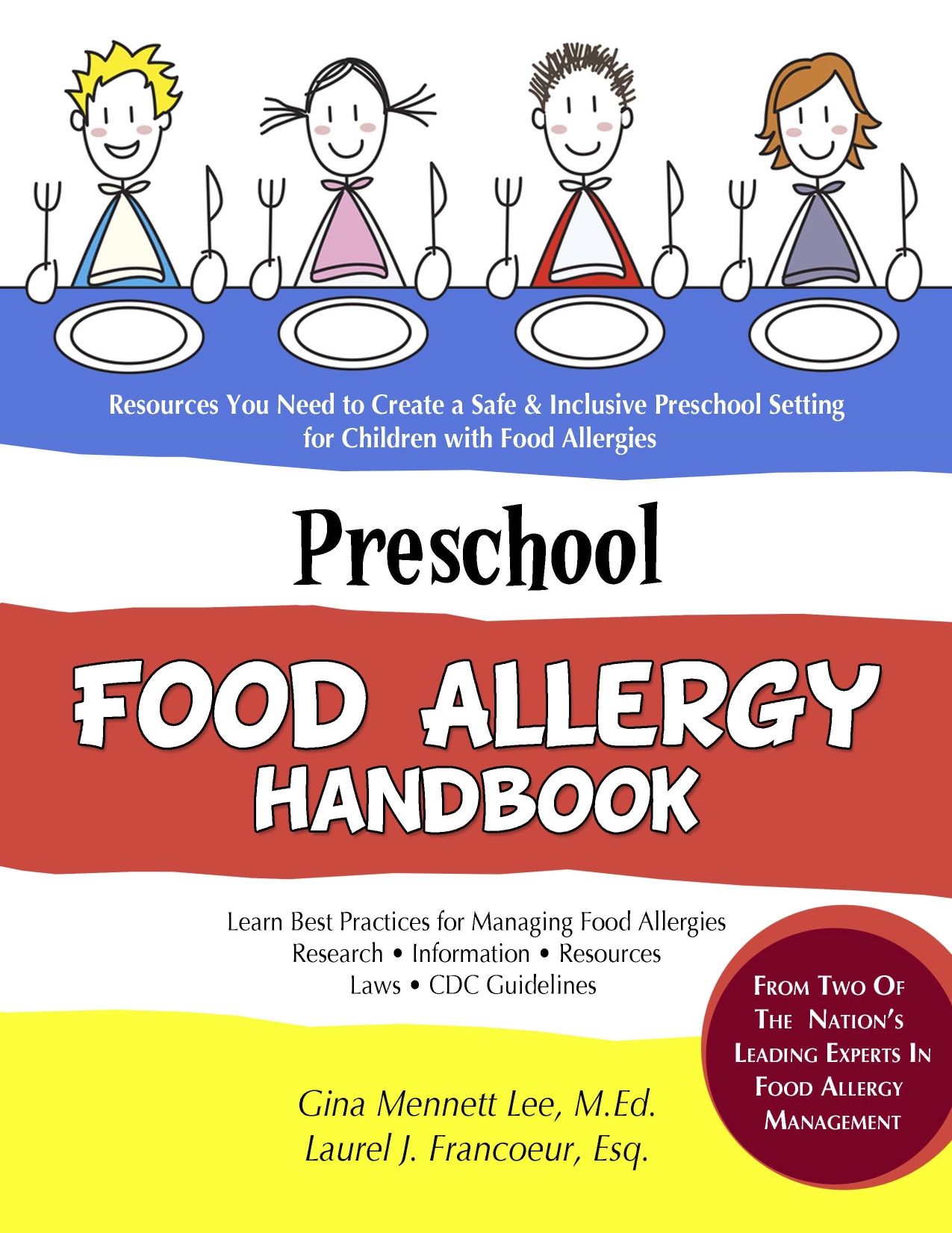
As mentioned in the webinar, Laurel and I have written a book that will be published in the coming months.  It’s called The Preschool Food Allergy Handbook.   If you would like to purchase the book or would like advanced notice, contact me and I will add you to our waiting list.

Be sure to visit FARE’s website to view all of their past webinars and to register for upcoming ones.  Thanks again FARE!

BEST Resources for Managing Food Allergies in the School Setting

Monday, December 2nd, 2013 | Permalink

By Gina Mennett Lee, M.Ed.

Food Allergy Educator and Consultant


Screen shot 2013-12-02 at 6.18.42 PM

I have been reading and analyzing everything food allergy related for the past 8 years.  From my perspective of both a food allergy advocate and a former teacher, here are the resource that I have found to be most helpful.  All of these can be found under the “resources” section of my website.


FREE RESOURCES:

FAEN You Could Save a Life…Poster 8 x 11- (Great for Lunchrooms, Classrooms, Teachers’ Rooms)

Potential Allergens in Preschool and School Activities (Table of allergens found in craft and art supplies)

FREE Teaching Tools for Children:

Be A P.A.L. Program (Appropriate for teaching other children about food allergies. Ages PreK-8.)

Everyday Cool with Food Allergies (Appropriate for teaching children about their food allergies.  Ages PreK-2.)

Hayden’s Food Allergy Video (Excellent video to teach other children about food allergies.  Ages PreK-4.)


Suggested Books to Use as Teaching Tools for Children (PreK-3):

The BugaBees: Friends with Food Allergies by Amy Recob

The BugyBops: Friends for All Time by Amy Recob

Everyday Cool with Food Allergies by Dr. Michael Pistiner

The Princess and the Peanut Allergy by Wendy McClure

The Princess and the Peanut by Sue Ganz-Schmitt

The Peanut Free Café by Gloria Koster

Nutley: the Nut-Free Squirrel by Stephanie Sorkin

Alexander the Elephant Series from FARE

Allie the Allergic Elephant, Cody the Allergic Cow and Chad the Allergic Chipmunk


FREE Training Tools for School Employees:

AllergyReady.com (This is a free, interactive training tool for school personnel.  It is very thorough and hits on almost all areas of food allergy management.   Employees can print out proof of completion.  It is created by a team of experts in the field of  food allergies. )

AllergyHome ( This is an excellent website created by two pediatric allergists.  There are many resources, all of them free.  I provided a link to a free training module for school personnel.  It is 30 minutes long and has a test at the end.)

The Food Allergy Book: What School Employees Need to Know  (This is a simple, easy to understand guide from the National Education Association.  It is appropriate for all school personnel.   You can download it for free or order hard copies to distribute.  You only pay for shipping.)


FREE Guides for Developing Policy:

Food Allergen Exposure in the School Setting (This is an excellent table to use when creating school-wide policy and/or when discussing individual accommodations.  It is based on the new CDC guidelines and references the latest facts and research in the food allergy world.)

School Food Allergy Education Table (Age-appropriate food allergy education based on CDC guidelines)

Safe at School and Ready to Learn (From the National School Board Association- the checklist on pages 18-33 is especially helpful.)

Voluntary Guidelines for Managing Food Allergy in Schools and Early Care and Education Programs (From the Centers of Disease Control )


If there are resources you feel I’ve missed, please let me know.

The School Access to Emergency Epinephrine Act. Now that it is Law, What Does it Mean?

Friday, November 15th, 2013 | Permalink

By Gina Mennett Lee, M.Ed.

Food Allergy Educator, Advocate & Consultant


What It Is.

This federal law provides incentive for states to pass laws that meet all of the requirements outlined below:

  1. States must grant rights for public school students to self-administer any asthma or anaphylaxis medication authorized by the student’s doctor (with conditions—see the law for details)
  2. State must require elementary and secondary public schools to permit authorized personnel to administer epinephrine to someone believed to be having an anaphylactic reaction.  They must also have stock epinephrine in a secure but accessible location.  The stock epinephrine must be prescribed via standing orders from a licensed physician,
  3. State must have Good Samaritan Law to protect those that “in good faith” administer the epinephrine to treat anaphylaxis

The incentive is that states meeting these requirements get preference when applying for asthma-related grants.


What it is NOT.


Probably more important that understanding what the law provides, is understanding what it does not provide.

  • It is not a mandate for all public schools to maintain a stock epinephrine.
  • It does not provide funding for schools to acquire stock epinephrine.
  • It does not provide funding directly to states for passing stock epinephrine laws.


Why is it important?

This law is important because it signifies an important step in the right direction.  In this current economic climate, many states have halted the passing of any legislation considered to be an “unfunded  mandate”.  By signing this into law, President Obama is acknowledging, on a national scale, the importance of stock epinephrine.  Hopefully, this will help those advocates on the state level add another bullet point to the “pros” of passing state law that mandates stock epinephrine in all public schools.   It is, however, only the beginning of the process.  Getting legislation passed in all 50 states is going to require a great deal of work from anaphylaxis educators and advocates in each of the states that currently do not have a stock epinephrine law.

BUY YOUR COPY TODAY!

"One Stop Food Allergy Book Has It All!" -GratefulFoodie

Subscribe to Blog via Email

Keep up-to-date on the latest news, research and resources in the world of food allergies by subscribing to my blog.

Disclaimer

The information provided on this website is not intended to be used as medical or legal advice, nor is it intended to diagnose health problems, to act as a substitute for a doctor, or to act as a substitute for a lawyer. Nothing on this website can replace the independent judgment of a licensed physician or lawyer. If you, or a member of your family, has or is suspected to have a medical condition, please consult your health care provider. This website is provided on an "as is" basis without warranties of any kind, express or implied, including those of title, merchantability, fitness for a particular purpose. The user assumes all responsibility and risk for the use of this website.