Posts Tagged education

Do You Know Your EPI?

Sunday, March 1st, 2015 | Permalink

By Gina Mennett Lee, M.Ed.   FoodAllergyConsulting.com

As part of our Beyond Awareness Food Allergy Educational Campaign for 2015, this month we are focusing on knowing how to use your epinephrine auto-injector.  This month’s campaign is hosted by friend and fellow food allergy advocate, Sharon Wong of NutFreeWok.  Her blog post is an excellent read and thoroughly explains our campaign.  Below I’ve provided my thoughts and a quick overview.

Screen shot 2015-03-01 at 4.09.18 PM

Why focus on epinephrine training?

A recent study from the University of Texas Medical Branch at Galveston found that out of 102 patients ONLY 16% used their epinephrine auto-injector correctly.

Screen shot 2015-03-01 at 5.22.48 PM


The most frightening statement was made by Rana Bonds, MD, ACAAI Fellow and lead author of the study.

“Most patients made multiple mistakes and would not have benefited from self-administration of the potentially life-saving treatment if the need arose.”

What can you do?

  • Be sure that you know how to use the epinephrine prescribed to you or your loved one.
  • Use an epi trainer regularly to make sure you remember.  (Experts recommend at least every 3 months.)
  • Ask your loved one with food allergies where they keep their epi and if they know how to use it.

Please help us to spread this important message by tweeting, sharing or blogging about this topic. Please tag it with #FAEC15 and feel free to share a link to your blog post here.

Links to instructional videos can be found below:

EpiPen
Auvi-Q
Adrenaclick
Epinephrine Autoinject

The “Beyond Awareness Educational Campaign” was created by Gina Mennett Lee, M.Ed. of Mennett Lee, LLC.  The purpose of the campaign is to harness social media to provide necessary education to the public regarding food allergy management.  Caroline Moassessi  of GratefulFoodie and Sharon Wong of Nut Free Wok have joined the campaign to provide an even greater reach.  We hope you will join our effort by sharing the campaigns on your social media outlets. Together we can make a difference.

#WhereIsYourEPI?

Wednesday, January 21st, 2015 | Permalink

By Gina Mennett Lee, M.Ed.

FoodAllergyConsulting.com

Moving beyond awareness to education:  Each month I will launching an educational campaign to help get important information about managing food allergies out to greater community.  I hope that you will join me!

The educational campaign for February is #WhereIsYourEPI?

The purpose of this campaign is to emphasize the importance of having epinephrine immediately available at all times.

#WhereIsYourEpi


Did you know that a delay in using epinephrine for a life-threatening reaction (anaphylaxis) can have a huge impact on the outcome of the patient and can even result in death? 
What research reveals:
  • The delay or non-use of epinephrine is risk factor for fatal anaphylaxis (more info here)
  • The later you use the epi, the higher likelihood of hospitalization (more info here)
  • In a recent survey, only 40% of those with life-threatening food allergies were carrying their epinephrine
No one plans to have an allergic reaction.
Reactions can happen ANYTIME, ANYWHERE.  That is why it is important that those with food allergies ALWAYS have epinephrine immediately available.

LET’S TURN THIS AROUND!

How can you help?

  1. Post the #WhereIsYourEPI? image (above) to social media.
  2. Ask your loved ones with food allergies this important question and encourage them to always have their epinephrine.
  3. Enter my contest. Let’s set a good example.  Show us how you keep epi immediately available at all times (whether at home, at school or out and about)  by posting a picture to my website or by posting to twitter and you will be entered to win a $50 Amazon Gift Card.*
* All twitter entries must be tagged with #WhereIsYourEPI? and @MennettLeeLLC  to be considered.  All website entries should be posted here.  Not tech savvy?  Send your submission to: gmleeconsulting@gmail.com.  By entering the contest, you allow Mennett Lee, LLC to use your image.  Contest ends February 14, 2015.  Winner will be selected on February 20, 2014.
Related Post:
New Food Allergy Agenda: Moving Beyond Awareness to Education


A Food Allergy Mission for 2015: Moving Beyond Awareness to Education

Thursday, January 1st, 2015 | Permalink

Screen shot 2014-12-31 at 8.10.02 PM

As 2014 comes to a close, it is a natural time for reflection.  In addition to making resolutions in my personal life, I have been thinking about our food allergy community and all that has happened this year.   There were high highs like Sean Parker donating $24 million to the cause, and the new and exciting research regarding food allergy therapies.   But there were also some very low lows.  The ignorance on display in Clawson immediately comes to mind.   The lows that tend to impact me most are the stories of food allergy deaths and the many calls and emails I receive from parents worried about exclusion and safety issues at school.  Most of these lows seem to have one common denominator: education.

When I first entered the world of food allergies, about a decade ago, there was little awareness of food allergies.  People had “heard” of peanut allergies but not much else.  It was important to bring awareness to the facts that: one, people can be allergic to any food;  and two, food allergies can be life-threatening.  But in the years since, I’ve seen a much greater need to move beyond awareness and to focus more of our efforts on effective and meaningful education.  Misinformation can be more dangerous than no information at all, and this is especially true for food allergy.

Misinformation can be more dangerous than no information at all, and this is especially true for food allergy.

So in the spirit of making resolutions for the New Year, I hope we can all resolve to work together to make EDUCATION the mission for 2015.

Here are What I View as the Top 5 Educational Priorities:

  1. The importance of food allergic individuals having epinephrine immediately available at all times
  2. How and when to use epinephrine
    • Effective epinephrine auto-injector training,
    • Emphasis on epinephrine as the first-line treatment for anaphylaxis
    • How to identify symptoms of anaphylaxis
  3. How to effectively implement the CDC Guidelines in every school, preschool, and daycare
  4. How food allergies impact individuals, families and communities
  5. How to include those with food allergies in their community


Additional Educational Priorities:

  • Food allergy testing and what it really means
  • How to effectively advocate for your child
  • How to effectively educate those around you
  • The concept of cross-contact (what it is and how to avoid it)
  • Methods of exposure to allergens
  • Labeling laws and their limitations

 In the coming months, I will do my best to advance the goal of education.  If all of us, in the food allergy community (doctors, nurses, non-profits, support group leaders, food allergy educators/consultants/coaches, parents, etc…) could focus on education with consistent messaging from vetted sources, I know we could make a true and lasting impact.  

Will you join me?  What do you see as a priority for 2015?  Is there anything you add to this list?


Support Kyle Dine’s Kickstarter Campaign

Friday, November 21st, 2014 | Permalink

Kyle

I first met Kyle in my role as President of Food Allergy Education Network.  We had hired him to be the entertainment for our Dance-a-thon fundraiser.  I had heard some of his songs, but had never seen him in action.

That May, he put on a show that had all the children singing and cheering that “Food Allergies Rock!”  He also sang about important messages like carrying and using epinephrine when needed.  He did it all in a fun, engaging and age appropriate manner using humor, puppets and songs.  I was hooked.  I became a Kyle Dine Fan immediately.

kids dancing with Kyle


Making a diagnosis, that is challenging at best and downright scary at its worst, into something fun and a point of pride is a spectacular feat!  That is why I was very excited when Kyle contacted me to tell me about his idea and to ask me to be an advisor for his new project.  He would like to spread his positive message and educational tools to a broader audience by creating a video.

In order to achieve this goal, he has launched a KickStarter Campaign to raise funds to create this video.  If you believe in using the power of fun and music to help educate children, I hope you will consider donating to this campaign.

(For the record: I was not asked to write about this campaign. I am offering my expertise on this project as a volunteer, not a paid consultant.  I believe strongly in importance of creating fun educational tools for children. )

It’s Up! FREE “Food Allergies in the Early Care Setting” Webinar (FARE)

Thursday, July 17th, 2014 | Permalink

By Gina Mennett Lee, M.Ed.

www.FoodAllergyConsulting.com


DC

The view from Ronald Reagan International Airport.  Unfortunately, it’s the only sightseeing I was able to fit in.


Last week, Laurel Francoeur and I traveled to Washington D.C. to present a webinar from Food Allergy Research & Education , Food Allergies in the Early Care Setting.    (Quest Diagnostics sponsored the webinar. We wanted to thank them and FARE for treating us so well and making us feel welcome.).


10306480_816198961732290_8401550201572619565_n

 Michael Spigler (FARE, Vice President of Education), Laurel and me

 The entire FARE staff was wonderful and it was great to finally see the world headquarter in person.  More importantly, we were thrilled to be able to provide such an important resource to the food allergy community. If you were not able to make the webinar, it is available to view online for FREE by clicking here.


webinar pic

Laurel and I before the webinar.


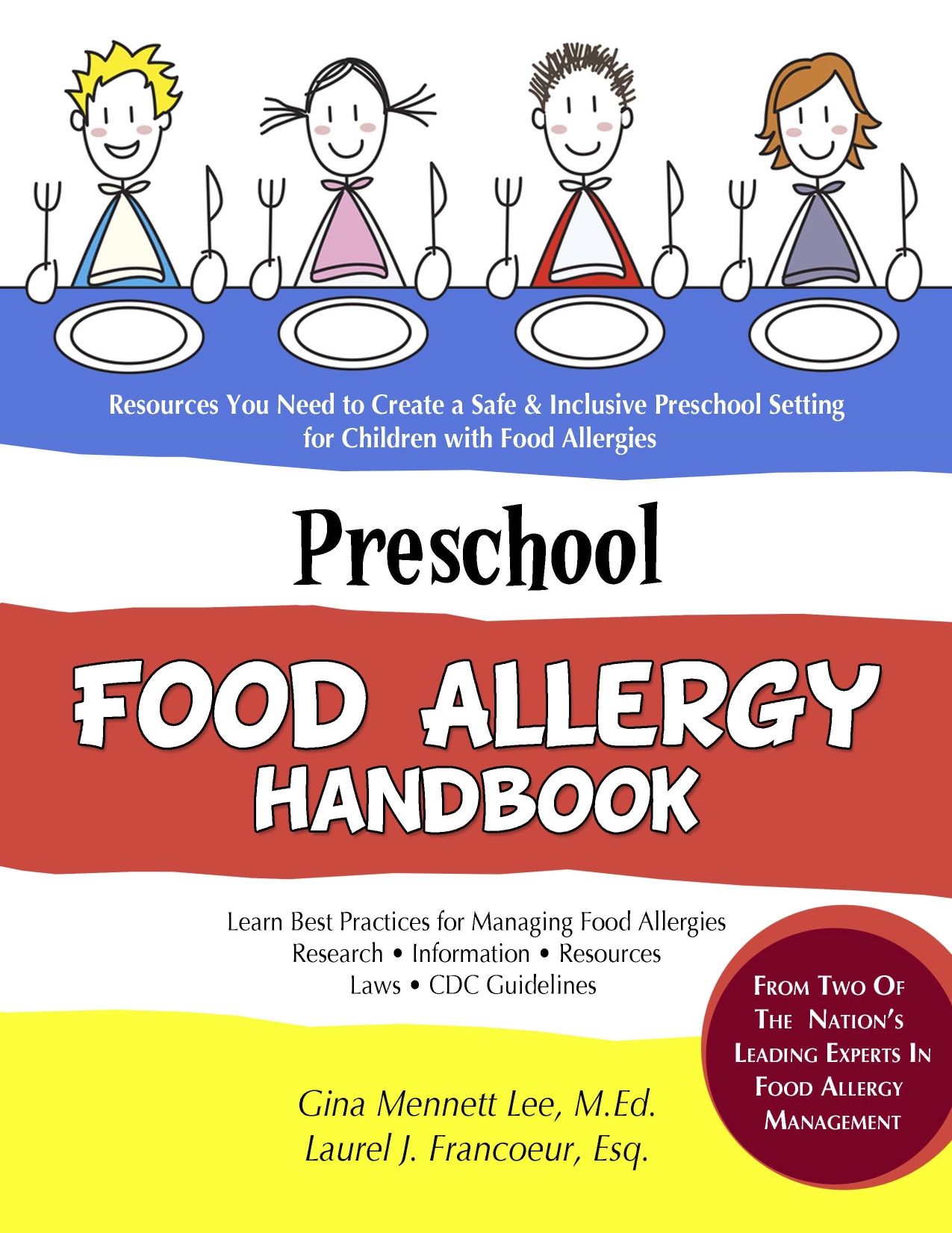
As mentioned in the webinar, Laurel and I have written a book that will be published in the coming months.  It’s called The Preschool Food Allergy Handbook.   If you would like to purchase the book or would like advanced notice, contact me and I will add you to our waiting list.

Be sure to visit FARE’s website to view all of their past webinars and to register for upcoming ones.  Thanks again FARE!

What Should Be Done to Protect Food Allergic Children in the School Setting?

Wednesday, January 29th, 2014 | Permalink

By Gina Mennett Lee, M.Ed.

Many schools and childcare centers are wrestling with this very question.  But the answer could be closer than one might expect.  Rules and expectations are a regular part of the school setting.  We just need to apply them to this specific concern.

Here is an example.

Many schools have programs that allow children to use technology in the classroom.  Recently, I was asked to review and sign a contract of rules the children needed to follow in order to use an ipad.   As I looked at the clearly defined, bulleted list of what was expected of the children in order to have the privilege of using a piece of equipment, it occurred to me how closely some of these resembled accommodations needed for children with food allergies.

IPAD Contract


Below is the content of the contract:

iPad Rules:

  1. Clean Hands-wash and dry hands before you use an iPad
  2. No Liquids-don’t have drinks around the iPad including water
  3. Be Gentle- treat the iPad with respect. Carry it carefully and set it down securely
  4. Follow Instructions-use only the apps that you have been given permission to use.
  5. Ask Questions-if you have a problem with the iPad, speak up and let you teacher know
  6. Sleep it-when the teacher is talking to the class, or you are not using the iPad, put it on the sleep setting

This was a formal written contract that needed to be signed and returned by every family in this classroom.  This was all to keep an $800 electronic device safe from harm.

 So my question is, if we can do all of this for a piece of  $800 equipment, how much more should we be willing to do to protect a child?

Many school districts and childcare centers still do not have written rules, policies or regulations in place to protect children with food allergies.

The CDC has provided guidance in this area by publishing their Voluntary Guidelines for Managing Food Allergies in Schools and Early Care and Education Programs.

AllergyHome provides this table with suggested accommodations, Food Allergen Exposure in the School Setting as well as a wealth of free resources.

FARE provides these tips for the classroom setting.

Kids With Food Allergies Foundation provides school resources here.

FAACT provides this Education Resource Center.


The common thread is that there must be rules put in place in order to protect children with food allergies.  These rules should be clearly written and easy for people to access.  Communication and implementation are key components of a successful plan.

Some common recommendations are to:

  • identify children at risk for an allergic reaction
  • create a plan specific to the needs of each identified child
  • train all adults responsible for children in the identification of an allergic reaction and how to use epinephrine
  • wash hands before and after eating
  • wash tables and chairs in the lunchroom before each lunch wave
  • check for allergens in food, crafts, cleaning supplies, soaps, lotions, and other classroom materials
  • have food-free classrooms or restrict food in the classroom
  • enforce a no food sharing rule
  • provide non-food items for rewards, birthdays, celebrations
  • provide allergen-free zones or seating
  • have rapid access to epinephrine
  • provide safe transportation
  • assess risks ahead of time when planning field trips or special guests in the classroom


What do you think?   For information on how your school or childcare center can implement the CDC guidelines, please contact Mennett Lee, LLC.  at gmleeconsulting@gmail.com.


* Disclosure:  I am a contributor to the AllergyHome website.


BUY YOUR COPY TODAY!

"One Stop Food Allergy Book Has It All!" -GratefulFoodie

Subscribe to Blog via Email

Keep up-to-date on the latest news, research and resources in the world of food allergies by subscribing to my blog.

Disclaimer

The information provided on this website is not intended to be used as medical or legal advice, nor is it intended to diagnose health problems, to act as a substitute for a doctor, or to act as a substitute for a lawyer. Nothing on this website can replace the independent judgment of a licensed physician or lawyer. If you, or a member of your family, has or is suspected to have a medical condition, please consult your health care provider. This website is provided on an "as is" basis without warranties of any kind, express or implied, including those of title, merchantability, fitness for a particular purpose. The user assumes all responsibility and risk for the use of this website.