Archive for the Free Resources Category
Thursday, April 9th, 2015 | Permalink
 Image of College of the Holy Cross, a participant in the FARE pilot program. (Image from news.holycross.edu)
Choosing the right college is an exciting and sometimes difficult prospect for any young adult. For those managing food allergies, it can especially challenging. Finding a college prepared and willing to accommodate food allergies can be just as important as the school’s educational offerings. That’s why I was thrilled to see FARE’s publication of the “Pilot Guidelines for Managing Food Allergies in Higher Education” as well as the announcement of a pilot program to implement these guidelines.
Twelve schools across the country have agreed to participate. This impressive list of higher education institutions are to be commended for being leaders in this movement to provide safe and accessible educational environments for those with food allergies.
- College of the Holy Cross (Worcester, Mass.)
- George Mason University (Fairfax, Va.)
- King’s College (Wilkes-Barre, Pa.)
- North Carolina State University
- Texas A&M University
- University of Arizona
- University of Chicago
- University of Michigan
- University of Northern Colorado
- University of Southern California
- Valparaiso University (Valparaiso, Ind.)
- Wesleyan University (Middletown, Conn.)
I look forward to hearing more about this program and I am very excited for the additional options that will be open to young adults entering college in the years to come. Thank you FARE for your commitment to the food allergy community.
Tags: college, FARE, food allergy, George Mason, guidelines, higher education, Holy Cross, King's College, North Carolina State University, pilot, Texas A&M, University of Arizona, University of Chicago, University of Michigan, University of Northern Colorado, University of Southern California, Valparaiso, Wesleyan
Posted in Blog, Food Allergies at School, Free Resources | No Comments »
Monday, January 5th, 2015 | Permalink
 I am so excited to share this excellent resource from the Asthma & Allergy Foundation of America. This is a topic that is near and dear to my heart as a food allergy consultant. At the Food Allergy Bloggers Conference last September, I was honored to speak about advocacy with Caroline Moassessi, Laurel Francoeur, and Jan Hansen. So I was thrilled when I heard that Caroline helped to create this resource for AAFA. Her knowledge and experience are on full display in this toolkit. This toolkit includes information on how to effectively communicate your message, the legislative process, using social media for advocacy, and much more. It is a must read for any advocate. Download it, read it and share it!
Tags: AAFA, advocacy, anaphylaxis, Caroline Moassessi, food allergy, gratefulfoodie, legislation, state
Posted in Blog, Food Allergies in the Community, Free Resources, In the News | No Comments »
Thursday, November 13th, 2014 | Permalink
I am already packed and ready to go! I am really looking forward to being part of this awesome conference spearheaded by Jenny Schumach of Food Allergy Association of Wisconsin and sponsored by Food Allergy Research and Education. It is a full day conference jam-packed with fabulous information and best of all, it’s FREE! It’s important for me to acknowledge Jenny and FARE for all their hard work and financial support of such an important educational conference. I am honored to be a part of what I view as a true service to the community. I can’t wait to hear my fellow food allergy educators speak.
I will be discussing one of my favorite topics, “Tools to Help Children Stay Safe and Included at School.” If you are attending, I hope you will come up and say “hello!”
Check out the conference agenda!
 For more information, visit HERE.
Tags: conference, FARE, food allergy, Food Allergy Association of Wisconsin, free, Gina Mennett Lee, school, speaking, Wisconsin
Posted in Blog, Food Allergies at School, Free Resources, In the News, Speaking Schedule, Training Tools | No Comments »
Monday, October 13th, 2014 | Permalink

I am so excited about the great resources developed this month for the food allergy community. Below are my Top 3.
The first is a tip sheet I was honored to create for Kids with Food Allergies, “Tips to Safely Celebrate Halloween.” It is a 2-page handout for both home and school and includes tips, reminders, craft ideas, non-food rewards and more.
The second resource is a blog post, “Finding Halloween’s Magic with Food Allergies,” written by my friend Caroline Moassessi for Allergic Living’s site. It is a wonderful piece with great ideas all written in Caroline’s signature style. I really like that it includes ideas for teens as well as younger children, as this age group is often overlooked.

The final resource is actually an initiative started by Food Allergy Community of East Tennessee. A year or two ago, the group shared the Teal Pumpkin Project. The concept is relatively simple, if you provide non-food treats simply paint a pumpkin teal and put it on your front door step. This allows families with food allergies or other food-related conditions to easily identify your “safe” house. I think it’s a fantastic idea and so does Food Allergy Research and Education. This year the non-profit greatly expanded upon the idea creating badges, flyers, and posters all in an effort to encourage people nationwide to participate. For free downloads, check here.
If you have any other great Halloween resources, please feel free to share them here.
Tags: Allergic Living, allergy, Caroline Moassessi, celebrate, craft, food, Halloween, ideas, Kids with Food Allergies, non-food rewards, safe, Teal Pumpkin Project, tips
Posted in Blog, Food Allergies at School, Free Resources, In the News, Training Tools | No Comments »
Monday, September 15th, 2014 | Permalink
Gina Mennett Lee, M.Ed.
FoodAllergyConsulting.com
This weekend, I was honored to be one of five speakers to present to a SOLD OUT audience in Saddle Brook, NJ hosted by the Asthma and Allergy Support Group of North Jersey. It was wonderful to see friends old and new. As promised, I am providing a list of resources that I presented (and a few I didn’t have a chance to present). Enjoy!
If you didn’t have a chance to at the conference, be sure to sign up for my newsletter by sending your name and email address to: gmleeconsulting@gmail.com. Also, be sure to sign up for my blog by entering your email to the right—–>>>> under “Subscribe to Blog via Email”.
Thank you!!
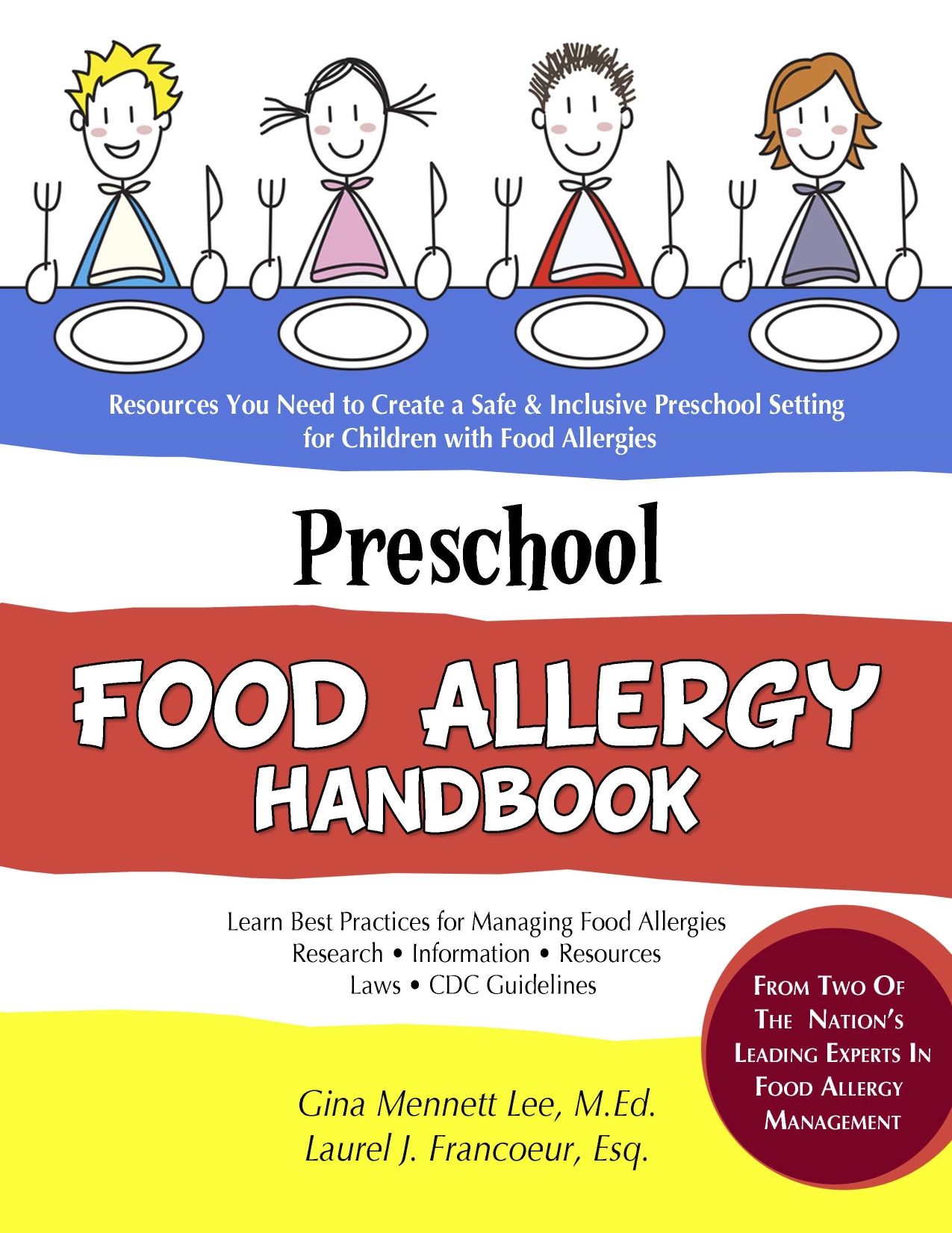
P.S. I also forgot to mention that I wrote a book with Laurel Franceour that will be available to purchase in later this month. It is called the “Preschool Food Allergy Handbook”. I will be offering a special price for those that attended the NJ conference. Stay tuned….

Free Posters:
Free Online Awareness Videos for Children without Food Allergies:
Hayden’s Food Allergy Video (YouTube): This provides an excellent, simple explanation of food allergies and how to keep friends with food allergies safe. It is appropriate for preschool through 4th grade.
Books for Children:
The BugaBees: Friends with Food Allergies
The BugyBops: Friends for All Time
The Princess and the Peanut Allergy by Wendy McClure
The Princess and the Peanut by Sue Ganz-Schmitt
The Peanut Free Café by Gloria Koster
Nutley: the Nut-Free Squirrel by Stephanie Sorkin
Free Handbook for School Employees:
The Food Allergy Book: What School Employees Need to Know (www.neahin.org)
Free Printable Activities for Children:
Be A P.A.L. (foodallergy.org)
No Biggie Bunch (nobiggiebunch.com)
National Guidelines for Developing Policy:
Safe at School and Ready to Learn
Voluntary Guidelines for Managing Food Allergy in Schools and Early Care and Education Programs
Tags: allergy, Allergy Eats, CDC, conference, Dr. Scott Sicherer, Dr. Wanich, food, Gina Mennett Lee, guidelines, List of resources, management, New Jersey, Paul Antico, school, Sloane Miller
Posted in Blog, Food Allergies at School, Free Resources, Speaking Schedule, Training Tools | No Comments »
Friday, September 12th, 2014 | Permalink
By Gina Mennett Lee, M.Ed.
FoodAllergyConsulting.com
It
Yesterday, Food Allergy Research and Education released “Creating a Food Allergy Safety Zone At Home” and I jumped for joy but not for the reasons you would expect. While I think this is a fantastic resource for the newly diagnosed, I believe it should be used to reach a much wider audience. This is the perfect tool to use to teach others about how to safely host someone with food allergies.
A few weeks ago, I took an informal poll on facebook. I asked, “What is the one aspect of food allergy management that you wish others understood?” By far, the area people wished others knew more about, was the concept of cross-contact. I find cross-contact to be the one of the most misunderstood concepts as well. People think that the only way to have a reaction is to directly ingest the food. When, in my personal experience, it’s much more difficult to avoid cross-contact. This is also what poses the greatest risk when people with food allergies eat away from home.
It’s the nuances of food allergy management that often are the most difficult to communicate.
Recently, a very kind mother offered to have my 9-year-old daughter over her house for dinner. She assured me that she would only serve safe foods. I was so thankful for her generous offer. I felt awful having to then engage in an awkward discussion about the fact that it’s not as easy as only serving safe foods. I told her about all the precautionary measures that would need be in place in order for my daughter to eat safely. Thankfully, she took it in stride and seemed willing to take on the responsibility (with help from me). She even went so far as to offer to host a few parents at her house for a “training” on how to safely host my daughter. I thought, “What a wonderful person!” Then, “That’s a great idea, but where do I begin!”
This guide is my answer. Although many of the tips are specific to the home of the food allergic person, there is a wealth of great information that could be used to educate those that wish to host a person with food allergies.
I love the kitchen dos and don’ts and the examples of direct and indirect cross-contact. This is exactly what I was looking for. It is straight-forward, easy to understand, and gives specific tips that can be immediately implemented. I recommend sharing this with family members, friends, coaches, PTA leaders, and school personnel as a way to communicate the precautions that are necessary to keep a child with food allergies safe when preparing or serving food.
Thank you Food Allergy Research and Education and Chef Joel Schaefer for making a valuable and effective resource! Now to begin preparing that parent training….
Related topics:
FREE POSTER: How to Read A Label for Food Allergens in 3 Easy Steps
Food Allergy Tips for PTA Leaders
Tags: cross-contact, dinner, Food Allergies At Home, food allergy, hosting, kitchen, label-reading, parents, preparing food, school, sleep-over
Posted in Blog, Food Allergies at Home, Food Allergies in the Community, Free Resources, Training Tools | No Comments »
Tuesday, September 2nd, 2014 | Permalink
By Gina Mennett Lee, M.Ed. (FoodAllergyConsulting.com)
One of the most important (and often the most challenging) aspects of food allergy management is learning how to read a label for allergens. In my role as a consultant, I’m often asked, “How do you read a label?” I’m excited to finally be able to share with a resource that I hope will help people with this task. It is my “Label Reading 1-2-3” poster.

I created a poster that shows you how to read a label the way I personally read a label. I try to quickly eliminate unsafe foods (Steps 1 & 2), but also take the time to read every ingredient of those foods that might be safe (Step 3).
This poster is available to download for FREE-HERE: Label Reading Poster Please share!!
For more information on our current labeling laws, be sure to read here.
Tags: allergens, FALCPA, food allergy, How to read a label, poster
Posted in Blog, Food Allergies at Home, Food Allergies at School, Food Allergies in the Community, Free Resources, Training Tools | 1 Comment »
Monday, July 28th, 2014 | Permalink
By Gina Mennett Lee, M.Ed.
Food Allergy Educator & Consultant
FoodAllergyConsulting.com

One of the most important skills in managing food allergies is the ability to identify an allergic reaction. Early identification is critical. I am sharing this FREE poster with you in hopes that you will download it and use it. The information provided on this resource is consistent with the CDC Guidelines.
I recommend that these be placed in school cafeterias and classrooms as a reminder to school personnel. Parents and other caregivers may also find it useful to post in the home on the fridge or in the kitchen.
DOWNLOAD HERE:
Poster 8.5 X 11
Poster 11X17
Related posts:
FREE Food Allergy Training Options for Schools
Managing Food Allergies in the Classroom: A Free Guide for Classroom Teachers
Best Resources for Managing Food Allergies in the School Setting
Tags: anaphylaxis, CDC, classroom, consulting, epinephrine, food allergy, free, Gina Mennett Lee, guidelines, lunch, management, nurse, poster, resource, school, symptoms. allergic reaction, teacher, training
Posted in Blog, Food Allergies at Home, Food Allergies at School, Food Allergies in the Community, Free Resources, Training Tools | No Comments »
Thursday, July 17th, 2014 | Permalink
By Gina Mennett Lee, M.Ed.
www.FoodAllergyConsulting.com

The view from Ronald Reagan International Airport. Unfortunately, it’s the only sightseeing I was able to fit in.
Last week, Laurel Francoeur and I traveled to Washington D.C. to present a webinar from Food Allergy Research & Education , Food Allergies in the Early Care Setting. (Quest Diagnostics sponsored the webinar. We wanted to thank them and FARE for treating us so well and making us feel welcome.).

Michael Spigler (FARE, Vice President of Education), Laurel and me
The entire FARE staff was wonderful and it was great to finally see the world headquarter in person. More importantly, we were thrilled to be able to provide such an important resource to the food allergy community. If you were not able to make the webinar, it is available to view online for FREE by clicking here.

Laurel and I before the webinar.
As mentioned in the webinar, Laurel and I have written a book that will be published in the coming months. It’s called The Preschool Food Allergy Handbook. If you would like to purchase the book or would like advanced notice, contact me and I will add you to our waiting list.
Be sure to visit FARE’s website to view all of their past webinars and to register for upcoming ones. Thanks again FARE!
Tags: CDC guidelines, daycare, early care, early childhood, education, FARE, food allergy, Food Allergy Research, free, Gina Mennett Lee, home care, Laurel Francoeur, laws, preschool, Preschool Food Allergy Handbook, resources, training, webinar
Posted in Blog, Food Allergies at School, Free Resources, In the News, Preschool, Speaking Schedule, Training Tools | No Comments »
Wednesday, April 9th, 2014 | Permalink
By Gina Mennett Lee, M.Ed.
The number of children with food allergies in the United States is now estimated to be 1 in 13. This means there are approximately 2 children in every classroom with food allergies. That number is especially alarming given that children with food allergies can be at risk for having a life-threatening reaction called anaphylaxis. As a classroom teacher, you spend the greatest amount of time with your students, aside from their families. You are also most likely to be the person who will first need to respond should a reaction occur. As a matter of fact, in a study of MA epinephrine use in schools, 45% of symptoms developed in the classroom. See graph below:

Hopefully your school has implemented a plan for the management of children with food allergies that is consistent with the newly released CDC guidelines. Whether this has occurred or not, there are still many things you can do as a classroom teacher to ensure that children with food allergies can fully and safely participate in your classroom. (Please note that older students should be active participants in the management of their food allergies.)
Below are some simple, common sense measures you can implement to ensure that children with food allergies are safe and included in your classroom.
1. Create a positive climate by fostering an understanding about food allergies. All eyes are on you and people will follow your lead. This includes children, parents, and other school employees.
- Students: It is important to note approximately 50% of children with food allergies report being bullied (31.5% of children with food allergies are bullied specifically due to their allergies). Consider doing a lesson about food allergies with your students. There are books and videos available for this use.
- Other Parents: Speak in a positive manner when discussing food allergy management in your classroom. I overheard a teacher making a negative comment about a new classroom food allergy policy at a parent night. As a result, other parents began to discuss food allergies in a negative manner. This fostered an atmosphere of resentment rather than support. Be aware of how powerful your words and actions are to those around you.
2. Reduce the risk of accidental exposure
- Recycled food containers: Are there any food containers being used in your classroom? If so, get rid of them. Trace amounts of allergens can be found in these containers. Even if there were a way to be absolutely sure there were no allergens in the container, it is unsettling for a child to have to use a container of a food he/she has been told not to touch.
- Soaps and Lotions: Do you have soaps or lotions for use in your classroom? Check the labels for allergens. Parents of children with food allergies are a good resource and are often happy to help with this.
- Art & Craft Supplies: Check the labels for each item to ensure they do not contain allergens. This may require a phone call to the manufacturer as craft labels are often more difficult to read. FALCPA (food allergy labeling law) does not apply to these products. Enlist the help of the parent to the food allergic child. They may have already checked these products or may be willing to help.
- Other Classroom Supplies: Go through additional classroom supplies including items such as science experiments and games to ensure they are free of allergens.
- Food storage: Where are lunches and/or snacks kept? Can they be kept in an area that is separate from the learning environment? Children with food allergies may need a special spot to keep their food that is away from the other foods in order to avoid cross-contact (separate cubby or locker).
- Hand washing: It is recommended that children wash hands before and after eating. Both soap and water, and commercial wipes are effective at removing allergens. (Please note that hand sanitizers do not remove allergens.)
- Birthdays, Rewards & Classroom Celebrations: It is recommended that you avoid using food as a rewards or for celebrations. This will significantly reduce the risk of accidental exposure. There are additional benefits to this as well. Children will not associate all fun with food.
- Food in the classroom: The safest and easiest option is keep classrooms free of food. This will automatically reduce the risk of accidental exposure and it has no impact on other children. It also allows you, as the classroom teacher, the ability to focus on learning rather than food allergy management. Realizing that this may not always be a possibility, I have created a chart of accommodations needed if food is present in the classroom.
ACCOMMODATIONS NEEDED

If you or your students eat breakfast, snacks, or lunch in the classroom, there will need to be a system in place to monitor the food being eaten to ensure that they do not contain allergens. The CDC guidelines recommend that no allergens be present in the classroom. (If the foods the children are eating are being sent in from home and NOT shared, you may be able to provide a list of “safe snacks” for the other parents in the classroom. It is important to note, however, that labels and manufacturing practices can change at any time.) The CDC guidelines also recommend that children wash their hands before and after eating and that all eating surfaces be cleaned.
Do not serve food to any child without the parent’s knowledge and consent. Gone are the days when you could surprise the class with some homemade cookies. There are too many risks associated with this, and many other food-related health issues affect children beyond food allergies. Make it a rule not to serve food without parent knowledge and consent. Even if you “know” the food is safe, please get permission before serving. For example, a child with a milk allergy can safely eat watermelon. However, if the sponge the person used to clean the cutting board for the watermelon was also used to wash a cup that contained milk, there now could be milk proteins present in the watermelon due to cross-contact.
3. Communicate:
- School Nurse: If you are fortunate enough to have school nurse available, speak with him/her about food allergies in general and about the specific needs of the children in your class as soon as possible. The sooner you are able to do this, the more time you will have to prepare your classroom.
- Past teachers: Talk to the teacher the child had the previous year to discuss strategies that worked well.
- Parents/Guardians of Child with Food Allergies: Meet the parents/guardians before school starts to discuss their child’s needs. Make communication a priority when dealing with the parents/guardians of a child with a food allergy. They will be extremely appreciative. As an added benefit, they can help you. Caring for a child with food allergies is a big responsibility and one that they fully understand.
- Other parents/guardians of children in your classroom: It is considered best practice to not have the child’s allergens in the classroom. Typically, the school nurse, principal or classroom teacher will send a letter home to classroom parents asking that food containing specific allergens not be eaten in the classroom. If snacks are consumed in the classroom, it can be helpful to create a list of safe snacks to send home to parents as well. However, please keep in mind that labels and manufacturing practices can change at any time. Some schools have opted to have only fruits and vegetables for snack time. The parents of children with food allergies may be willing to offer suggestions for a safe snack list.
- Be sure to respect the child’s privacy. It is the law. It’s important not to use the child’s name or give details of the child’s medical history without permission from the parent.
- Substitute teachers : How will you communicate the needs of the child with food allergies to substitutes? Will it be in your sub folder? How will you ensure that the sub reads it? Will there be a specific sub assigned to your classroom that has been trained and is aware of the needs of the children in your class?
- Special guests: Whenever someone comes into your room, there is a risk that they may bring something unexpected. For example, a parent volunteer may walk in with a coffee that contains milk, or a guest speaker may bring in a craft supply that contains an allergen. Do as much planning as you can in advance. Discuss guests with the parents of the food allergic child, when possible. They may be able to anticipate potential risks. (If the child is old enough, you may discuss it with the child directly.) Be prepared to respond if someone does bring an allergen into the classroom. Some teachers post signs outside the classroom as a reminder that the classroom is allergen-free.
- Field trips: Again, communicate with the child’s parents/guardians in advance of the trip. Some things you can prepare for and others you cannot. The child with food allergies should always be with a chaperone who is trained and has immediate access to the child’s medication. It’s also good idea to travel with wipes and keep them with you at all times. It can be helpful for unexpected clean-ups and hand washing. Always offer to allow the child’s parent to attend field trips.
4. Be prepared to respond should a reaction occur
- Training: Have you been trained to recognize the symptoms of an allergic reaction? Do you know how to respond? Do you understand the child’s Food Allergy Action Plan/Emergency Care Plan? Do you know who is repsonsible for administering the epinephrine? If you are responsible, have you been trained and are you comfortable using the epinephrine auto-injector? Do you know who is responsible for calling 911 and what to say? (If not, discuss creating a 911 script with your school nurse and/or principal and post it near the phone and keep it with emergency communication devices when away from the classroom.)
- Emergency Communication: Do you have a way to directly contact emergency services at all times during the school day? (This includes recess and other times you are not in your classroom.)
- Medication: Where will medication be kept? Is the child old enough to self-carry? If not, will the medication be kept in your classroom? (One suggestion is to hang a zippered pouch from a hook that is too high for children to reach but easily accessible to adults.)
- Don’t be afraid to use the epinephrine auto-injector. It will save the child. It will not hurt them. If state law/regulations and local policy allow you to administer epinephrine, ask your school nurse if there is an opportunity to try administering an expired epinephrine injector it into a grapefruit. This will allow you to experience how a real auto-injector feels. Depending on the type of auto-injector the child is prescribed, it can feel quite different from the trainer.
5. Be confident. Once you have implemented these strategies, you should feel confident that you can provide a safe and welcoming environment that will allow all of your students to grow as learners and as people.
I have created a FREE checklist for managing food allergies in the classroom. 

* * Data taken from The Management of Life Threatening Allergies in School: Lessons Learned from Massashusetts By Michael Pistiner MD, MMSc and Anne H. Sheetz RN, MPH, NEA-BC.
Thank you to Julia Verillo, B.A. Elementary Education (3rd grade teacher in CT), and Tina Stewart, M.Ed. (3rd grade teacher in MA) for reviewing this article.
Resources:
Food Allergen Exposure in the School Setting
The Management of Life Threatening Allergies in School: Lessons Learned from Massachusetts, Epinephrine Administration in Schools Brief Summary
Voluntary Guidelines for Managing Food Allergies in Schools and Early Care and Education Programs
Tags: allergyhome, Anne Sheetz, CDC, checklist, classroom, consultant, CT, data, downloadable, Dr. Mike Pistiner, epinephrine, food, food allergy, free, Gina Mennett Lee, guide, guidelines, management, policy, preschool, regulations, resources, school, setting, statistics, teacher
Posted in Blog, Food Allergies at School, Free Resources, Training Tools | 3 Comments »