The Preschool Food Allergy Handbook plus FREE Poster!
ONLY $25 and only at LaurelLeeAcademy.com


Monday, December 1st, 2014 | Permalink
Wednesday, October 22nd, 2014 | Permalink

Book release and sneak peek!!
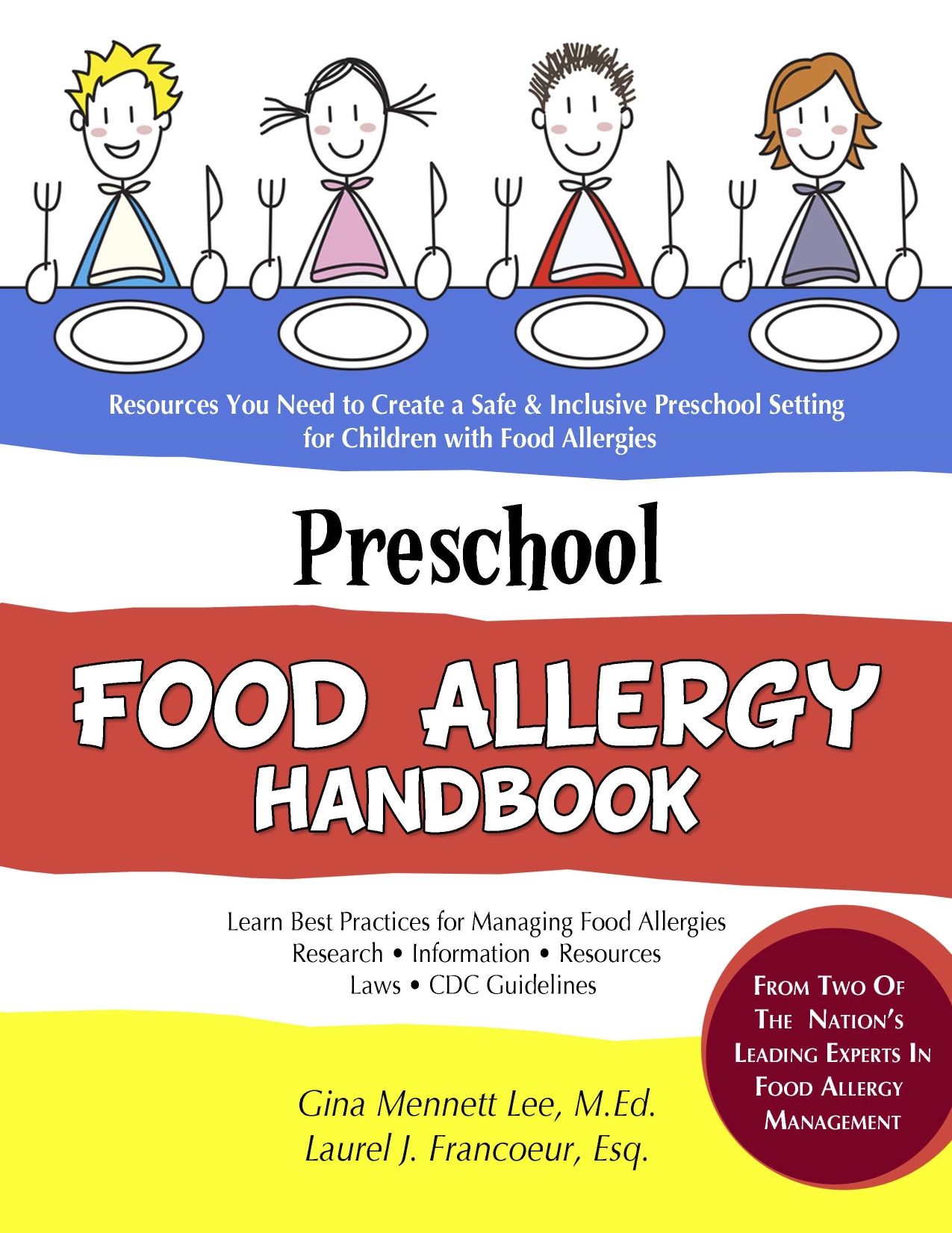
Laurel Francoeur and I put the finishing touches on our new book, the Preschool Food Allergy Handbook, this September. We launched it at the Food Allergy Bloggers Conference and were overwhelmed by the support of this much needed book addressing the preschool setting.
For those of you that aren’t able to meet us in person at one of our book signings, we wanted to give you a little sneak peek.


There are so many wonderful resources we created just for this book that cannot be found anywhere else.
We also included the best resources currently available.
To order yours, visit Amazon.com. A special thank you to The Bugabees: Friends With Food Allergies
and Kyle Dine for sponsoring our book!
Thursday, July 17th, 2014 | Permalink
By Gina Mennett Lee, M.Ed.
www.FoodAllergyConsulting.com

The view from Ronald Reagan International Airport. Unfortunately, it’s the only sightseeing I was able to fit in.
Last week, Laurel Francoeur and I traveled to Washington D.C. to present a webinar from Food Allergy Research & Education , Food Allergies in the Early Care Setting. (Quest Diagnostics sponsored the webinar. We wanted to thank them and FARE for treating us so well and making us feel welcome.).

Michael Spigler (FARE, Vice President of Education), Laurel and me
The entire FARE staff was wonderful and it was great to finally see the world headquarter in person. More importantly, we were thrilled to be able to provide such an important resource to the food allergy community. If you were not able to make the webinar, it is available to view online for FREE by clicking here.

Laurel and I before the webinar.
As mentioned in the webinar, Laurel and I have written a book that will be published in the coming months. It’s called The Preschool Food Allergy Handbook. If you would like to purchase the book or would like advanced notice, contact me and I will add you to our waiting list.
Be sure to visit FARE’s website to view all of their past webinars and to register for upcoming ones. Thanks again FARE!
Tuesday, July 1st, 2014 | Permalink
Allergic Living is a magazine that I greatly respect and feel provides excellent and necessary content each and every issue. Coming from a “publishing” family, I truly appreciate all the hard work that goes into producing such a top-notch publication.

Because of this, I was truly honored to write an article for the latest issue of Allergic Living, “Daycare Allergy Rights Case: Where Does It Leave Us.” The article is about a landmark food allergy suit in Iowa. I had the distinction of being a part of this case as an expert witness. The article provides significant details of the lawsuit as well as practical tips for both parents and providers. You will also get to see the courageous family behind this case. I hope you will find the information useful! Please let me know your thoughts.
Of course, as always, the issue is also chocked full of information and resources for the food allergy/intolerance/celiac community.
Wednesday, April 9th, 2014 | Permalink
By Gina Mennett Lee, M.Ed.
The number of children with food allergies in the United States is now estimated to be 1 in 13. This means there are approximately 2 children in every classroom with food allergies. That number is especially alarming given that children with food allergies can be at risk for having a life-threatening reaction called anaphylaxis. As a classroom teacher, you spend the greatest amount of time with your students, aside from their families. You are also most likely to be the person who will first need to respond should a reaction occur. As a matter of fact, in a study of MA epinephrine use in schools, 45% of symptoms developed in the classroom. See graph below:

Hopefully your school has implemented a plan for the management of children with food allergies that is consistent with the newly released CDC guidelines. Whether this has occurred or not, there are still many things you can do as a classroom teacher to ensure that children with food allergies can fully and safely participate in your classroom. (Please note that older students should be active participants in the management of their food allergies.)
Below are some simple, common sense measures you can implement to ensure that children with food allergies are safe and included in your classroom.
1. Create a positive climate by fostering an understanding about food allergies. All eyes are on you and people will follow your lead. This includes children, parents, and other school employees.
2. Reduce the risk of accidental exposure
ACCOMMODATIONS NEEDED

If you or your students eat breakfast, snacks, or lunch in the classroom, there will need to be a system in place to monitor the food being eaten to ensure that they do not contain allergens. The CDC guidelines recommend that no allergens be present in the classroom. (If the foods the children are eating are being sent in from home and NOT shared, you may be able to provide a list of “safe snacks” for the other parents in the classroom. It is important to note, however, that labels and manufacturing practices can change at any time.) The CDC guidelines also recommend that children wash their hands before and after eating and that all eating surfaces be cleaned.
Do not serve food to any child without the parent’s knowledge and consent. Gone are the days when you could surprise the class with some homemade cookies. There are too many risks associated with this, and many other food-related health issues affect children beyond food allergies. Make it a rule not to serve food without parent knowledge and consent. Even if you “know” the food is safe, please get permission before serving. For example, a child with a milk allergy can safely eat watermelon. However, if the sponge the person used to clean the cutting board for the watermelon was also used to wash a cup that contained milk, there now could be milk proteins present in the watermelon due to cross-contact.
3. Communicate:
4. Be prepared to respond should a reaction occur
5. Be confident. Once you have implemented these strategies, you should feel confident that you can provide a safe and welcoming environment that will allow all of your students to grow as learners and as people.
I have created a FREE checklist for managing food allergies in the classroom. 

* * Data taken from The Management of Life Threatening Allergies in School: Lessons Learned from Massashusetts By Michael Pistiner MD, MMSc and Anne H. Sheetz RN, MPH, NEA-BC.
Thank you to Julia Verillo, B.A. Elementary Education (3rd grade teacher in CT), and Tina Stewart, M.Ed. (3rd grade teacher in MA) for reviewing this article.
Resources:
Food Allergen Exposure in the School Setting
Voluntary Guidelines for Managing Food Allergies in Schools and Early Care and Education Programs
Thursday, March 13th, 2014 | Permalink
I am truly honored to be an expert contributor to the highly respected AllergyHome website. AllergyHome provides some of the best food allergy resources for the school setting . AllergyHome’s mission is to “bring food allergy awareness and education to your community.” If you haven’t already, please take the time to look through the website. You will find training modules, posters and other fabulous FREE resources.
Today, I’d like to share two resources that I am proud to have been a part of creating. I will be adding links to these under the resources tab of my website. (There are other AllergyHome resources listed there as well.)
The first resource is Food Allergy Tips for PTA Leaders but it can be shared with school administrators, nurses, and teachers as well. I create this Tip Sheet in collaboration with AllergyHome Co-Creator, Dr. Michael Pistiner.

DOWNLOAD HERE: Tip Sheet for PTA Leaders
Dr. Pistiner also did an excellent blog post for the National PTA entitled, “Anaphylaxis, A How-To Readiness Guide for Schools” I highly recommend taking the time to read it.
The second resource is Food Allergy Tips for Coaches and Activity Leaders. Please print this out and share with coaches, scout leaders, after-school program coordinators, etc…

DOWNLOAD HERE: Food Allergy Tips for Coaches and Activity Leaders
I hope you find these useful. If you haven’t already, make sure to sign up to receive my blog posts. I will continue to share useful resources as I find them. If you have additional questions regarding accommodations for children with food allergies, please feel free to contact me.
Wednesday, January 29th, 2014 | Permalink
By Gina Mennett Lee, M.Ed.
Many schools and childcare centers are wrestling with this very question. But the answer could be closer than one might expect. Rules and expectations are a regular part of the school setting. We just need to apply them to this specific concern.
Here is an example.
Many schools have programs that allow children to use technology in the classroom. Recently, I was asked to review and sign a contract of rules the children needed to follow in order to use an ipad. As I looked at the clearly defined, bulleted list of what was expected of the children in order to have the privilege of using a piece of equipment, it occurred to me how closely some of these resembled accommodations needed for children with food allergies.

Below is the content of the contract:
iPad Rules:
This was a formal written contract that needed to be signed and returned by every family in this classroom. This was all to keep an $800 electronic device safe from harm.
So my question is, if we can do all of this for a piece of $800 equipment, how much more should we be willing to do to protect a child?
Many school districts and childcare centers still do not have written rules, policies or regulations in place to protect children with food allergies.
The CDC has provided guidance in this area by publishing their Voluntary Guidelines for Managing Food Allergies in Schools and Early Care and Education Programs.
AllergyHome provides this table with suggested accommodations, Food Allergen Exposure in the School Setting as well as a wealth of free resources.
FARE provides these tips for the classroom setting.
Kids With Food Allergies Foundation provides school resources here.
FAACT provides this Education Resource Center.
The common thread is that there must be rules put in place in order to protect children with food allergies. These rules should be clearly written and easy for people to access. Communication and implementation are key components of a successful plan.
Some common recommendations are to:
What do you think? For information on how your school or childcare center can implement the CDC guidelines, please contact Mennett Lee, LLC. at gmleeconsulting@gmail.com.
* Disclosure: I am a contributor to the AllergyHome website.
"One Stop Food Allergy Book Has It All!" -GratefulFoodie
