Archive for the Blog Category

Top 3 Non-Negotiables for Food Allergy Accommodation Plans

Monday, December 8th, 2014 | Permalink

By Gina Mennett Lee, M.Ed.

FoodAllergyConsulting.com

Hopefully, if you have been reading my work, you know that I stress the importance of an individual written plan for each child with a food allergy.  The importance of an individual plan is echoed in the CDC guidelines.   These plans should address strategies to prevent a reaction as well as what to do should a reaction  occur.  Individual accommodations will differ depending on the child’s allergies and the unique educational setting of the school.  However, there are a few accommodations that I personally hold firm as non-negotiables.  These three accommodations will inform the remainder of the necessary accommodations for each child.

hand stop


1. Immediate access to epinephrine: Every allergist I have spoken to or listened to at conferences (and this includes many of top allergists in the United States) stresses the importance of always having epinephrine with the child.  Why should this NOT be the case at school?  When reviewing research and individual cases of food allergy deaths, delay in administration of epinephrine is often one of the most important factors.  Recently, additional research was published drawing a connection between the delay of the use of epinephrine and the increased amount of time a person was hospitalized.  The message is clear, the sooner the epinephrine is administered, the better the outcome.  Make sure every child has immediate access to this life-saving medication.

2. Supervision by trained staff:  This should be a no-brainer.  If the those supervising the child throughout the school day are not trained to identify the signs of an allergic reaction or trained to administer the epinephrine, there will be a delay in treatment or possibly no treatment at all.  This can have dire consequences.  In some states, there are laws that prohibit certain people from administering epinephrine. If this is the case, alternative plans need to be put in place to ensure each child has immediate access to someone that can administer epinephrine.  All staff can be trained to identify symptoms of an allergic reaction and to prevent reactions from occurring.  This supervision must be in place at all times including on the bus or at before and after school activities.

3. Allergen-free classrooms:  This measure is firmly supported by the CDC.  Children attend school to learn. All children deserve to learn in a safe environment.  For children with food allergies this means an environment free of their allergens.  They should not be put in a situation where they are distracted from their primary goal by having to worry about their allergens.  In addition, I  want teachers to be able to focus on teaching rather than the management and proper clean-up of allergens.  Given that 45% of allergic reactions requiring epinephrine begin in the classroom, reducing the amount of “unnecessary food” as well as eliminating allergens is a safe and effective way to reduce the likelihood of a reaction.

Other points to consider:

Allergens can remain on surfaces that appear to be clean.

Research indicates that adults touch their faces numerous times per hour and that children ages 2-5 touch their faces 40 times per hour.  This means that a student with an allergy can unknowlingly touch their allergen and then touch their eyes, nose or mouth and suffer a reaction as a result.

Often these measures are put in place at a young age.  However, teens and young adults should be given the opportunity to learn in an environment free of their allergens as well.  Teens are at a higher risk of a fatal allergic reaction.  We need to continue to protect these children.


These three accommodations are a solid starting point of an effective plan.

Related posts:

Top 3 Actions Every Preschool Must Take to Protect Students with Food Allergies

FREE Food Allergy Training Options for Schools

Food in the Classroom Not About Public Opinion


There is a Responsibility that Comes with Having a Voice

Tuesday, November 25th, 2014 | Permalink

By Gina Mennett Lee, M.Ed.

FoodAllergyConsulting.com

22thereisaresponsibility0athatcomeswithhavinga0avoice220a-default

I have been asked to speak about the topic of being thoughtful about our words and actions when communicating in public many times over the past few months.  I usually use this quote during the presentations and I think it is worth sharing in light of what took place at a Clawson, Michigan Board of Education meeting.  After making an inappropriate remark that spawned a flurry of responses from the food allergy community, the woman who made the remark resigned from her position.  (to read more, click HERE)

Was her resignation an appropriate response?

In my opinion it is the least that she could do. (I’d also like to see a public apology from her and an effort for her to become educated about food allergies and their management. Her statements were hurtful to the food allergy community and also no doubt to those impacted by school shootings. )  No doubt, all of us have said things we wished we hadn’t and I am sure this woman regrets her statement.  However, as I stated in a previous post, we must hold our elected officials to a high standard of behavior.  When given a public position, your voice represents more than just yourself or your family.  You represent the community you serve and become role model.  It is a huge responsibility and one that should not be entered into lightly.

When someone in the public eye makes such a hurtful and insensitive comment in a public forum (in a televised/recorded meeting no less), it is imperative that action be taken that is in alignment with the morals and values of that community.  It important to those that were hurt by the comment to see that action has been taken and it is important to our children that we practice what we practice what we preach and we set a positive example.  As members of the community holding people accountable is the very least that we can do and is our responsibility as a society.

What do you think?


Children with Food Allergies Should Be Shot?

Tuesday, November 25th, 2014 | Permalink

A child’s safety is not a joke.

I usually don’t waste my time responding to inappropriate comments made by ignorant people regarding food allergies. I’d rather spend my time educating others and working for positive change.  However, this remark just could not and should not be ignored. It was made by a member of a board of education in Clawson, Michigan.  I only viewed the short clip shown here. In the clip, it sounds as though a faculty member is asking the board to address food allergy management citing that there is at least one child in every classroom now.  In response to this, a BOE member, identified on the site as Linda Grossman, states, “Well you should just shoot them.”  Laughter is heard after the remark from several people.

To view for yourself, see this link.

This is an unacceptable “joke” in age where school shootings are real threats and bullying of food allergic children is at a whopping 45%.  I often speak about the impact of our words and actions as adults.  It is unacceptable for any person to suggest such a horrific deed, but  I hold our public officials to an even higher standard.  Board of Education members are tasked with overseeing the health, safety and education of the children in their care. This type of comment is in direct conflict with that responsibility.  It is ignorant at best and careless, heartless and downright dangerous at it’s worst.

I sincerely hope that this school district takes the appropriate action here and sends a strong message to their community that joking about “shooting” children is NEVER acceptable and ALL children are deserving of a safe and healthy environment in which to learn.

Please feel free to post your thoughts on this issue.

Support Kyle Dine’s Kickstarter Campaign

Friday, November 21st, 2014 | Permalink

Kyle

I first met Kyle in my role as President of Food Allergy Education Network.  We had hired him to be the entertainment for our Dance-a-thon fundraiser.  I had heard some of his songs, but had never seen him in action.

That May, he put on a show that had all the children singing and cheering that “Food Allergies Rock!”  He also sang about important messages like carrying and using epinephrine when needed.  He did it all in a fun, engaging and age appropriate manner using humor, puppets and songs.  I was hooked.  I became a Kyle Dine Fan immediately.

kids dancing with Kyle


Making a diagnosis, that is challenging at best and downright scary at its worst, into something fun and a point of pride is a spectacular feat!  That is why I was very excited when Kyle contacted me to tell me about his idea and to ask me to be an advisor for his new project.  He would like to spread his positive message and educational tools to a broader audience by creating a video.

In order to achieve this goal, he has launched a KickStarter Campaign to raise funds to create this video.  If you believe in using the power of fun and music to help educate children, I hope you will consider donating to this campaign.

(For the record: I was not asked to write about this campaign. I am offering my expertise on this project as a volunteer, not a paid consultant.  I believe strongly in importance of creating fun educational tools for children. )

Heading to Wisconsin!!

Thursday, November 13th, 2014 | Permalink

I am already packed and ready to go!  I am really looking forward to being part of this awesome conference spearheaded by Jenny Schumach of Food Allergy Association of Wisconsin and sponsored by Food Allergy Research and Education.  It is a full day conference jam-packed with fabulous information and best of all, it’s FREE!    It’s important for me to acknowledge Jenny and FARE for all their hard work and financial support of such an important educational conference.  I am honored to be a part of what I view as a true service to the community.  I can’t wait to hear my fellow food allergy educators speak.

I will be discussing one of my favorite topics, “Tools to Help Children Stay Safe and Included at School.”  If you are attending, I hope you will come up and say “hello!”

Check out the conference agenda!

Screen shot 2014-11-13 at 11.14.39 AMFor more information, visit HERE.


Top 3 Actions Every Preschool Must Take to Protect Students with Food Allergy

Thursday, October 30th, 2014 | Permalink

By Gina Mennett Lee, M.Ed.  FoodAllergyConsulting.com

1: Identify students with food allergies and create a WRITTEN, Individual Plan of Accommodation.  This plan should include strategies to prevent exposure to allergens throughout the school day as well as how to respond should a reaction occur.


Screen shot 2014-07-16 at 10.55.42 AM2. Train ALL staff to identify symptoms of an allergic reaction and to respond appropriately.  If allowed by state and local law, train ALL staff how to administer epinephrine.

(See FREE Food Allergy Training Options for Schools)

3. Have immediate access to epinephrine at all times. Children with food allergies must be supervised by a trained adult at all times.

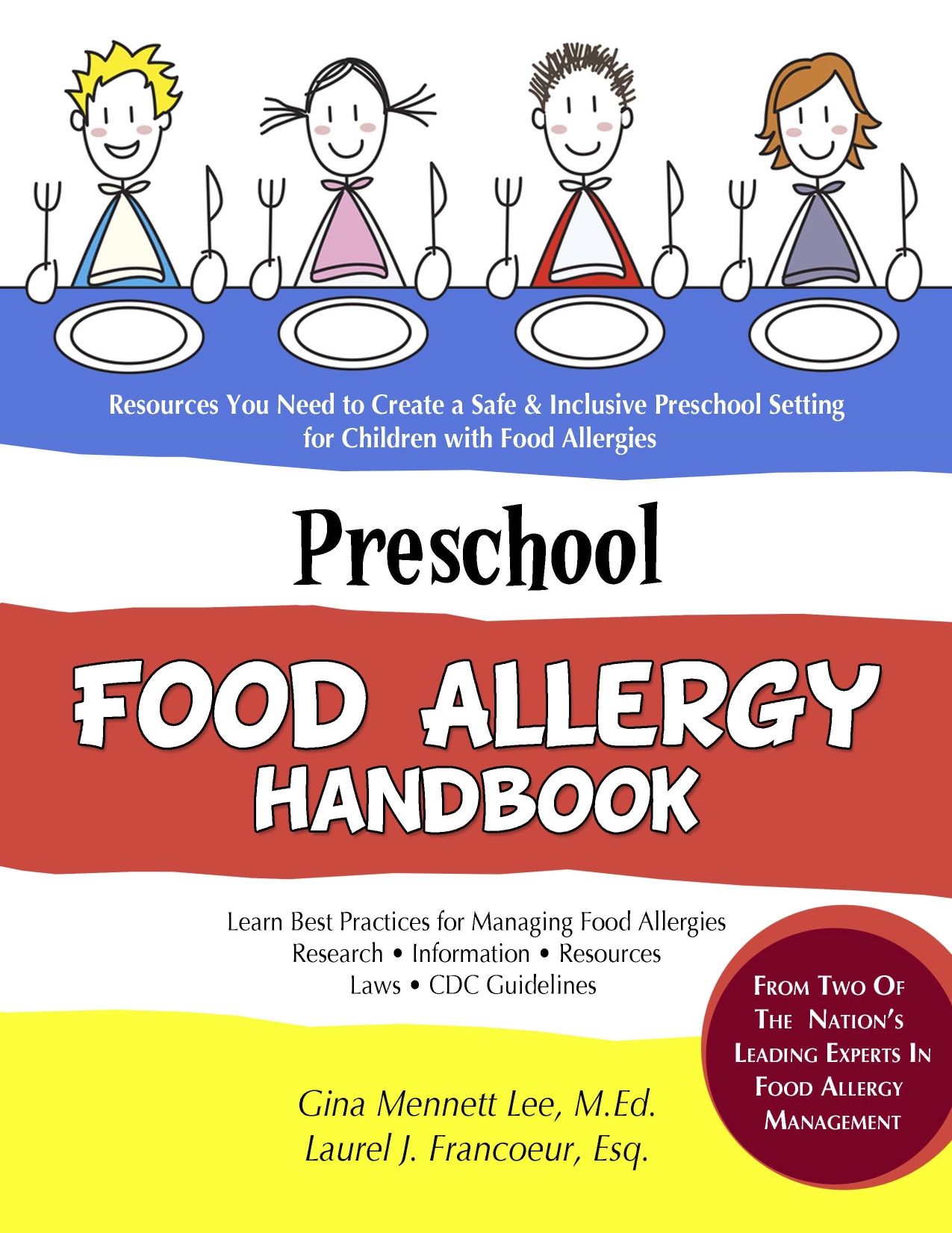
For more information on how to create a safe and inclusive environment for children with food allergies, please read the Preschool Food Allergy Handbook
.

Preschool Food Allergy Handbook: Book Release & Sneak Peek

Wednesday, October 22nd, 2014 | Permalink

Allergy Cover


Book release and sneak peek!!

Laurel Francoeur and I put the finishing touches on our new book, the Preschool Food Allergy Handbook, this September. We launched it at the Food Allergy Bloggers Conference and were overwhelmed by the support of this much needed book addressing the preschool setting.

For those of you that aren’t able to meet us in person at one of our book signings, we wanted to give you a little sneak peek.

Screen shot 2014-10-22 at 6.18.46 PMScreen shot 2014-10-22 at 6.17.30 PM


There are so many wonderful resources we created just for this book that cannot be found anywhere else.

  • How Will Your School Prepare for Food Allergy Emergencies?  Important Questions to Answer
  • Overview of Labeling Laws
  • How to Create a Healthy & Safe Educational Environment
  • How to Prevent Cross-Contact
  • Food Allergy Management and Prevention Plan Worksheet
  • Parent Checklist
  • Questions to Ask When Looking for a Preschool


We also included the best resources currently available.

  • How a Child Might Describe a Reaction
  • Label Reading 1-2-3
  • Tips for Avoiding Your Allergen
  • Free Staff Training Options
  • List of Free Educational Resources for Children
  • Children’s Book List
  • Books for Parents List
  • and much, much more….

To order yours, visit Amazon.com.  A special thank you to  The Bugabees: Friends With Food Allergies

and Kyle Dine for sponsoring our book!


Inclusion Means Everyone: The TEAL PUMPKIN PROJECT

Monday, October 20th, 2014 | Permalink

TEAl Pumpkin 1

Next Friday night as I put our Teal Pumpkin outside on my front steps, I will say a silent prayer of thanks to a mom I have never met, in a state far from my own, who decided to share a simple but wonderful idea.

What was her idea?   Place a teal pumpkin on your doorstep to let trick-or-treaters know that you provide non-food treats.

We did not wish to exclude candy but instead wanted to add another option of a safe alternative to be available,” states Becky Basalone of FACET.

Because of Becky Basalone and the Food Allergy Community of East Tennessee (FACET), the entire food allergy community now has a common gesture to bring us all together.  Thanks to the marketing muscle of Food Allergy Research & Education, the most amazing part of this campaign is that it has reached beyond our tight-knit food allergy community out to the general public.  It has united neighborhoods, schools, and towns in a way no other food allergy movement has.  From the farmer in Tennessee that decided to sell teal pumpkins, to my cousin in Ohio that chose to join in for no other reason but to support children with food allergies, this project has reached far and wide all in the name of inclusion.

We are a stonger community

We want to raise awareness of food allergies and other dietary issues that may restrict/limit certain food products, like candy, due to health risk,” explains Becky.  However, this project has become more than a campaign to raise awareness.  It has made me us all a part of something much larger than ourselves.  By putting out a teal pumpkin, we are sending a very clear message to all children: “WE CARE ABOUT YOU.”  I cannot think of a better message can we send this Halloween.


To join the movement on facebook, click HERE.

For free flyers and posters visit Food Allergy Research and Education.

For a list of non-food rewards from Kids with Food Allergies, click here.


What are food allergies revealing about our society?

Friday, October 17th, 2014 | Permalink

By Gina Mennett Lee, M.Ed.  FoodAllergyConsulting.com

“It takes a village to raise a child. It takes a child with autism to raise the consciousness of the village.” Coach Elaine Hall

This quote was shared by Dr. Rob Melillo via twitter this morning and it immediately struck a cord. It so perfectly captures how I feel about food allergies (as well as autism and other disabilities). These children are here to teach us lessons such as strength, compassion, perseverance, selflessness and unconditional love.  As much as I wish there were no such thing as a food allergy, I am thankful for what this condition has taught me and my family.  But what is this condition telling us about our society?  Have food allergies raised the consciousness of the village?

Have food allergies raised the consciousness of the village?

I believe that we will eventually find a cure for food allergies.  Effective treatments are already on the horizon.  But I am more concerned about the fallout from this chapter in our history.   I have experienced unkind behavior from others in response to my child’s medical condition and I’ve heard many stories too offensive to even repeat. Just take a look at the “comments” section of any mainstream media article about food allergies and you will see firsthand the anger and resentment thrust upon the food allergy community.

“I try to view misunderstandings as an opportunity to educate.”

I believe the majority of these comments are the result of misplaced anger, ignorance and misunderstandings.  I see these responses as an opportunity to educate.  I have to believe that if people really understood the seriousness of food allergies, the social and emotional impact of it, that they would do all they could to support adults and children with this condition.  So, I continue to work, to educate, to advocate.

So, my questions to you are:

What have food allergies revealed about your community?

What has your child taught you?

AWESOME Food Allergy Resources for Halloween

Monday, October 13th, 2014 | Permalink


halloween-clipart-free-LcK7g9Kca


I am so excited about the great resources developed this month for the food allergy community. Below are my Top 3.

The first is a tip sheet I was honored to create for Kids with Food Allergies, “Tips to Safely Celebrate Halloween.”  It is a 2-page handout for both home and school and includes tips, reminders, craft ideas, non-food rewards and more.

The second resource is a blog post,  “Finding Halloween’s Magic with Food Allergies,” written by my friend Caroline Moassessi for Allergic Living’s site.  It is a wonderful piece with great ideas all written in Caroline’s signature style.  I really like that it includes ideas for teens as well as younger children, as this age group is often overlooked.

Screen shot 2014-10-13 at 5.18.21 PM

The final resource is actually an initiative started by Food Allergy Community of East Tennessee.  A year or two ago, the group shared the Teal Pumpkin Project. The concept is relatively simple, if you provide non-food treats simply paint a pumpkin teal and put it on your front door step.  This allows families with food allergies or other food-related conditions to easily identify your “safe” house.  I think it’s a fantastic idea and so does Food Allergy Research and Education.  This year the non-profit greatly expanded upon the idea creating badges, flyers, and posters all in an effort to encourage people nationwide to participate.  For free downloads, check here.

If you have any other great Halloween resources, please feel free to share them here.

BUY YOUR COPY TODAY!

"One Stop Food Allergy Book Has It All!" -GratefulFoodie

Subscribe to Blog via Email

Keep up-to-date on the latest news, research and resources in the world of food allergies by subscribing to my blog.

Disclaimer

The information provided on this website is not intended to be used as medical or legal advice, nor is it intended to diagnose health problems, to act as a substitute for a doctor, or to act as a substitute for a lawyer. Nothing on this website can replace the independent judgment of a licensed physician or lawyer. If you, or a member of your family, has or is suspected to have a medical condition, please consult your health care provider. This website is provided on an "as is" basis without warranties of any kind, express or implied, including those of title, merchantability, fitness for a particular purpose. The user assumes all responsibility and risk for the use of this website.